Horse Racing Odds Explained: Fractional, Decimal and How Bookmakers Set Prices
 Available in US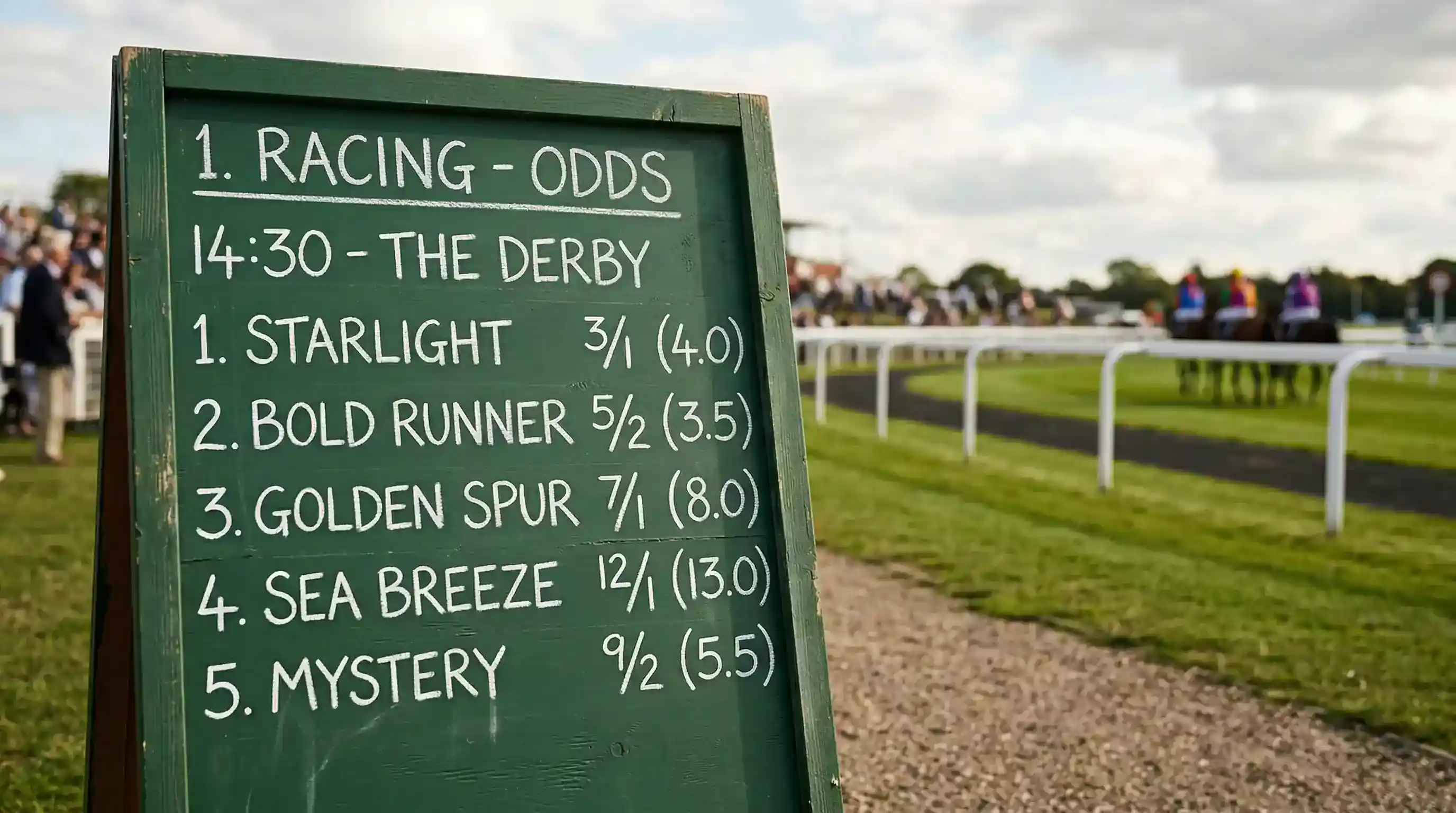
Table of Contents
- What Odds Tell You — and What They Hide
- Fractional Odds: The Traditional UK Format
- Decimal Odds and Why Some Punters Prefer Them
- What Odds-On Really Means (and Why It’s Not a Sure Thing)
- Starting Price, Early Price and Board Price: Which Matters
- The Overround: How Every Bookmaker Guarantees a Margin
- How to Spot Value in a Horse Racing Market
- Best Odds Guaranteed: A Quick Note
- Frequently Asked Questions
What Odds Tell You — and What They Hide
Nine years ago, I placed my first bet on a horse called Arctic Fire at Leopardstown. The odds were 5/1. I had no idea what that meant — genuinely none. I just liked the name and the number looked big enough to be exciting. The horse finished third. I lost my fiver and walked away thinking the whole system was rigged against anyone who hadn’t grown up around racecourses.
It wasn’t rigged. I was just illiterate — odds-illiterate, specifically. And that’s a fixable problem. Understanding odds is the single most important skill in horse racing betting, more important than reading form, more important than knowing your trainers, more important than any tipster’s nap of the day. Odds are the language the market speaks, and if you can’t read them, you’re placing bets with a blindfold on.
UK horse racing generates over 766 million pounds in gross gaming revenue from online betting alone each year. That money flows through a system built entirely on odds — fractional, decimal, starting price, early price, implied probability. Every one of those terms has a direct impact on what you win, what you lose, and whether the bet was worth placing at all. This guide breaks each one down, starting with the format you’ll see on every racecard and betting slip in Britain.
Here’s what most beginner guides won’t tell you: odds don’t just reflect how likely a horse is to win. They also reflect how much the bookmaker plans to keep for themselves. Understanding that distinction is the difference between betting and betting intelligently. By the end of this piece, you’ll know how to read both sides of the equation.
Fractional Odds: The Traditional UK Format
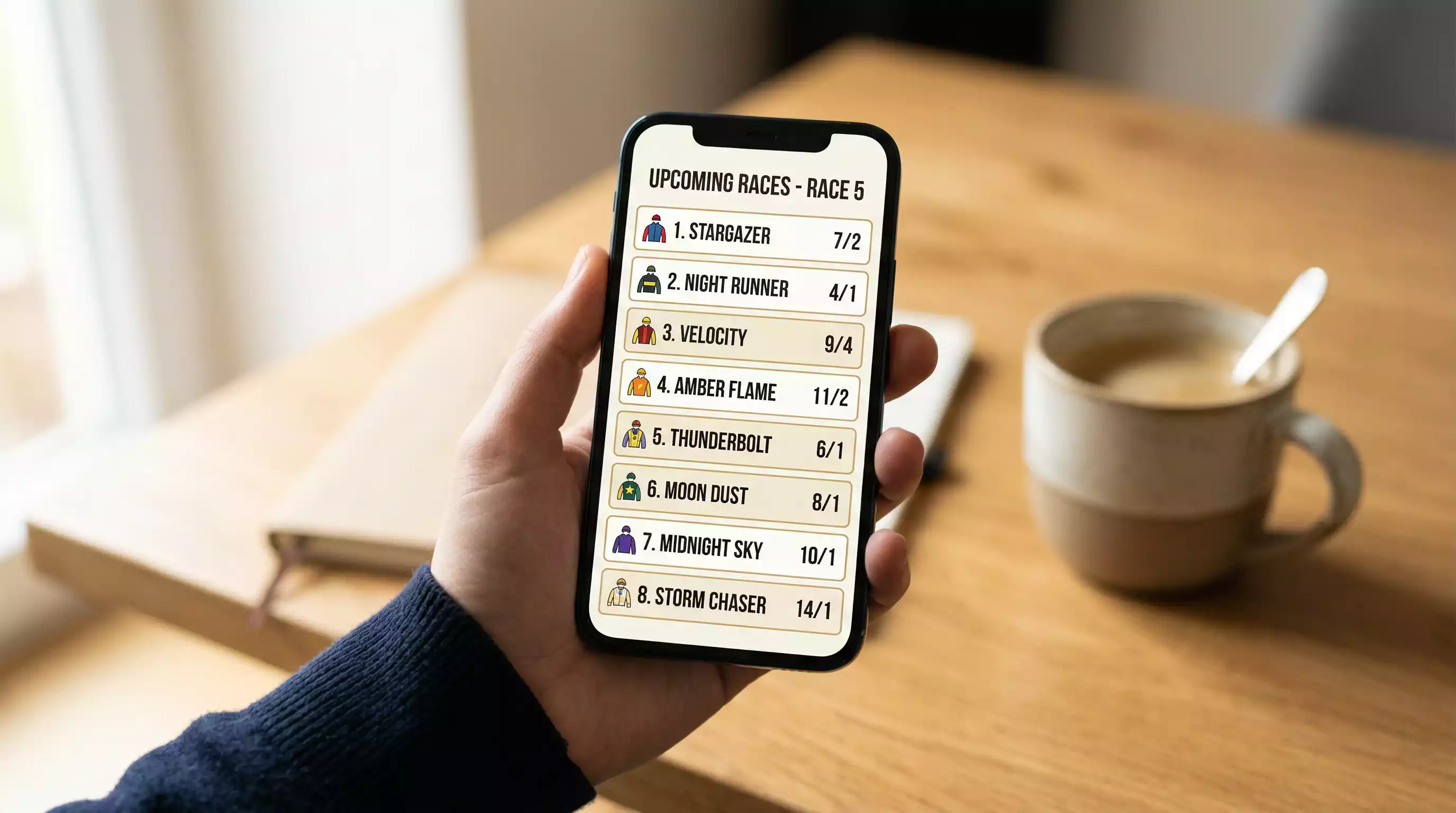
Walk into any betting shop in the UK and the screens will be covered in numbers that look like fractions from a maths lesson you’ve long forgotten. 5/1. 11/4. 9/2. 100/30. The format feels archaic because it is — fractional odds have been the standard in British racing since the 18th century, and the industry shows zero interest in abandoning them.
The good news: fractional odds are simpler than they look. The number on the right is your stake. The number on the left is your profit. That’s the whole system. If a horse is priced at 5/1 and you bet 1 pound, you make 5 pounds profit plus your original stake back — 6 pounds total. At 3/1, a 10 pound bet returns 40 pounds (30 profit plus your 10 stake).
Where it gets slightly trickier is the irregular fractions. 11/4 doesn’t divide cleanly into whole numbers, and that’s deliberate. Bookmakers use these granular prices to set markets precisely. To calculate 11/4, divide 11 by 4 to get 2.75 — that’s your profit per pound staked. A 4 pound bet at 11/4 earns 11 pounds profit plus the 4 pound stake, totalling 15 pounds. A 1 pound bet earns 2.75 pounds profit, returning 3.75 pounds.
The formula stays the same regardless of the numbers: divide the left by the right, multiply by your stake, then add your stake back. I use it dozens of times a day and it becomes automatic within a week of regular racing.
Some common prices and what they translate to per pound staked:
- Evens (1/1) — 1 pound profit per pound staked, 2 pounds total return
- 2/1 — 2 pounds profit, 3 pounds total return
- 5/2 — 2.50 pounds profit, 3.50 pounds total return
- 9/4 — 2.25 pounds profit, 3.25 pounds total return
- 7/2 — 3.50 pounds profit, 4.50 pounds total return
- 10/1 — 10 pounds profit, 11 pounds total return
- 33/1 — 33 pounds profit, 34 pounds total return
One thing that trips new punters up: odds of 5/2 and 2/5 are completely different animals. 5/2 means you profit 5 pounds for every 2 staked — a decent return on a competitive selection. 2/5 means you profit only 2 pounds for every 5 staked — a heavy favourite where you’re risking more than you stand to gain. The order of the numbers matters enormously, and mixing them up is the kind of mistake that costs real money.
If you remember one thing from this section, make it this: the bigger the left number relative to the right, the bigger the potential payout and the less likely the bookmaker thinks the horse will win. A 20/1 shot is a longshot. A 1/5 shot is near-certain in the market’s eyes. Everything in between is where the real betting decisions happen.
Decimal Odds and Why Some Punters Prefer Them
I resisted decimal odds for years. They felt continental, foreign, like ordering in metric when you’ve always thought in miles. Then I started doing payout calculations for accumulator bets and realised that decimal odds turn a multi-step maths problem into one multiplication. I haven’t looked back.
Decimal odds show your total return per pound staked, including the stake itself. A horse at 6.00 in decimal means every pound returns 6 pounds — that’s 5 pounds profit plus the original stake. The equivalent fractional price is 5/1. At 3.50 decimal (equivalent to 5/2 fractional), a 10 pound bet returns 35 pounds total. No separate addition step. No dividing fractions. Just multiply.
The conversion between formats is straightforward. To go from fractional to decimal, divide the fraction and add 1. So 9/4 becomes (9 divided by 4) + 1 = 3.25. To go back, subtract 1 from the decimal and express it as a fraction: 3.25 minus 1 = 2.25, which is 9/4. After a few conversions, you stop needing to convert at all — the numbers start mapping to each other in your head.
Where decimal odds really earn their keep is in multiples. If you back three horses in an accumulator at 5/2, 3/1 and 7/4, calculating the combined fractional return is a headache. In decimal — 3.50, 4.00 and 2.75 — you just multiply: 3.50 x 4.00 x 2.75 = 38.50. A 1 pound accumulator returns 38.50 pounds. Done in seconds, and you can do it on your phone’s calculator without writing anything down.
Most UK betting sites let you toggle between fractional and decimal in your account settings. I’d recommend switching to decimal for a few weeks even if it feels uncomfortable. The numerical clarity is worth the adjustment period. You can always switch back, but in my experience, people rarely do.
One subtle advantage: decimal odds make it immediately obvious when a horse is odds-on. Any price below 2.00 means you’re risking more than you stand to gain. In fractional odds, you need to parse whether 4/6 or 8/13 is odds-on. In decimal, anything under 2.00 jumps off the screen.
What Odds-On Really Means (and Why It’s Not a Sure Thing)
A colleague once told me that the safest bet in racing is backing the odds-on favourite. He said it with such confidence that I almost believed him. Then I tracked his bets for a month and watched him lose money steadily — not because the favourites weren’t winning, but because the returns when they did win couldn’t cover the losses when they didn’t.
An odds-on horse is any selection priced below evens — below 1/1 fractionally, below 2.00 in decimal. At odds of 4/7, for instance, you need to stake 7 pounds to profit just 4 pounds. The bookmaker is telling you this horse is very likely to win. And they’re usually right — horses at 4/7 win more often than they lose. The problem is that “more often” doesn’t mean “often enough to be profitable.”
Here’s the maths. At 4/7, the implied probability is about 63.6%. If the horse wins exactly 63.6% of the time and you back it every time, you break even. But bookmaker odds include a margin — the real probability might be closer to 60%, which means you lose in the long run despite backing winners regularly. You win most of your bets and still end up poorer. It’s a psychological trap that catches more beginners than any other.
Common odds-on prices and what they actually require to break even:
- 1/2 (1.50 decimal) — needs to win 66.7% of the time
- 4/7 (1.57 decimal) — needs to win 63.6%
- 4/6 (1.67 decimal) — needs to win 60.0%
- 4/5 (1.80 decimal) — needs to win 55.6%
- 10/11 (1.91 decimal) — needs to win 52.4%
None of this means odds-on horses are bad bets. It means they need to be right bets. If I genuinely believe a horse has a 75% chance of winning and it’s priced at 4/7 (implied 63.6%), that’s still a value bet — I’m getting better odds than the horse deserves. The price alone doesn’t determine whether a bet has merit. The relationship between the price and the actual probability is what matters, and that’s true at every point on the odds spectrum.
Starting Price, Early Price and Board Price: Which Matters
The morning of the 2024 Cheltenham Gold Cup, I took an early price on a selection at 7/1. By the time the race went off, the starting price had drifted to 9/1. If I’d waited, I’d have made significantly more from the same bet on the same horse. That stung — but the opposite has happened to me just as often, where an early price of 8/1 contracted to 4/1 by post time. Timing is everything in odds, and understanding the three price types helps you make better decisions about when to pull the trigger.
The starting price, or SP, is the final price of a horse at the moment the race begins. It’s determined by on-course bookmakers in the ring — the people standing with their boards at the racecourse. SP exists as an industry-wide reference point and as a fallback: if you place a bet without specifying a price (rare online, common on-course), you get SP. The remote gambling sector — bookmakers and exchanges — generated record gross margins in early 2025, with Alan Delmonte of the Horserace Betting Levy Board noting that particularly bookmaker-friendly outcomes at the Cheltenham Festival shaped those results.
An early price is any odds offered before race day — sometimes days or weeks in advance. Early prices tend to be available on the major races and give you a chance to lock in value before the market moves. The risk is clear: you commit to a price before all the information is in. The going might change, a key jockey might switch rides, or the horse might work poorly in the morning and drift dramatically.
Board price sits between the two. It refers to the odds displayed by on-course bookmakers during the pre-race betting period, usually from about 15 minutes before the off. Board prices fluctuate as money comes in. If punters pile onto one horse, its board price shortens while others lengthen. These movements are visible on live betting shows and on most bookmaker apps if you watch the price changes in real time.
For online bettors, the practical distinction is between taking an early price and taking SP. When you click on an odds button on a betting app, you’re locking in that price at that moment — it won’t change even if the market moves afterwards. If you select “SP” instead, your payout is determined by whatever the starting price turns out to be. I almost always take the price I can see rather than gambling on SP, because a known quantity beats an unknown one. But on days when I suspect a horse will drift — perhaps because of uncertain weather or a weak market — SP can occasionally work in your favour.
The turnover dynamics across different tiers of racing tell an interesting story. Average turnover per race on Premier fixtures — the big festival days and high-profile meetings — held steady through 2025, while Core fixtures saw a decline of over 8%. That gap reflects where the serious money goes and where casual punters concentrate their attention. For beginners choosing when to bet, Premier meetings offer deeper markets, more stable pricing and generally more reliable SP readings.
The Overround: How Every Bookmaker Guarantees a Margin
Let me show you something that changed how I think about every market I’ve ever bet into. Take a hypothetical three-runner race with the following prices: Horse A at 6/4, Horse B at 2/1, Horse C at 5/1. Convert each to an implied probability — that’s 1 divided by the decimal equivalent. Horse A: 1/2.50 = 40%. Horse B: 1/3.00 = 33.3%. Horse C: 1/6.00 = 16.7%. Add them up: 40 + 33.3 + 16.7 = 90%.
Wait. Shouldn’t the probabilities of all possible outcomes add up to 100%? In a fair market, yes. In a bookmaker’s market, never. Those numbers would add to something like 115% or 120%, not 90%. I deliberately used generous odds to illustrate the concept — real bookmaker markets always sum to more than 100%. That extra percentage above 100 is the overround, also called the vig, the juice, or the margin. It’s the bookmaker’s built-in profit mechanism.
Here’s a realistic example. Five runners, all priced by a bookmaker: 2/1, 3/1, 5/1, 8/1, 12/1. The implied probabilities are 33.3%, 25%, 16.7%, 11.1% and 7.7%. Total: 93.8%. But convert the bookmaker’s actual offered odds and you’d find something closer to 118% or 120%. Each horse’s price is slightly shorter than it should be — the bookmaker has shaved a bit off every selection. That’s the overround in action.
To calculate it yourself: convert every runner’s fractional odds to decimal, then to an implied probability (1 divided by the decimal price), sum all the probabilities, and subtract 100. A five-runner handicap at a typical UK meeting might carry an overround of 15 to 25%. A competitive big-field handicap at Cheltenham or Ascot might be tighter — 10 to 15% — because bookmakers compete harder for business on marquee races. An obscure Monday evening meeting at a smaller track could run as high as 30%.
What does this mean for you as a punter? Every bet you place has a built-in headwind. Even if your selection assessment is perfectly calibrated, the overround means you’re buying at a slightly inflated price. Over hundreds of bets, that margin compounds. It’s the reason most punters lose in the long run and the reason bookmakers post consistent profits year after year.
The overround isn’t a secret or a scam — it’s the cost of the service. Bookmakers provide liquidity, settle markets instantly, offer promotions and streaming. The margin pays for all of that. But knowing it exists — and knowing how to check it — gives you a framework for deciding which markets offer the best value for your money. A race with a 12% overround is a fundamentally better betting proposition than one with a 28% overround, all else being equal.
How to Spot Value in a Horse Racing Market
The first time someone told me to “look for value,” I thought they meant finding long-priced winners. It took embarrassingly long to realise that value has nothing to do with the size of the odds and everything to do with the gap between what the bookmaker thinks and what you think.
A horse at 3/1 has an implied probability of 25%. If your own analysis — based on form, going, class and connections — tells you the horse has a 35% chance of winning, that’s a value bet. You’re getting 3/1 on something you rate as closer to 2/1. Over time, consistently finding these gaps is how the small minority of profitable punters stay ahead. Overall betting turnover on British racing fell 9% in the first quarter of 2025 compared to the same period in 2024. Tighter markets and fewer casual bettors mean the remaining money is sharper — which makes value harder to find but more rewarding when you do.
Spotting value requires two things: a reliable method for estimating a horse’s actual chance of winning, and the discipline to compare that estimate against the available price before betting. Most beginners skip the first step entirely — they look at odds, decide they “like” a horse, and back it. That’s entertainment, not analysis. There’s nothing wrong with it, but it’s not a path to long-term results.
My own approach starts with three questions. First, does this horse’s recent form justify its position in the market? A horse that has been running consistently in the first three or four in competitive races and is now priced at 8/1 might be undervalued. Second, is there a factor the market might be underweighting — a change in going, first-time blinkers, a switch to a course that suits the horse’s running style? Third, how does the overround in this race affect the available price? A horse that looks like value at 5/1 in a tightly-priced market might not be value at 5/1 in a market with a 25% overround, because the “true” odds could be closer to 6/1 if the margin were stripped out.
Value betting is a long-term game. Any individual value bet can lose — and most do, by definition, because you’re often backing horses that aren’t favourites. The edge shows up over hundreds of bets, not over an afternoon. That requires record-keeping, patience and the emotional resilience to lose repeatedly while trusting the process. It also requires honest self-assessment: if your “value” picks are consistently losing at a rate worse than their implied probability, the problem isn’t the market. It’s your analysis. The detailed mechanics of building this discipline fit into a broader bankroll management strategy that I’d recommend learning alongside the odds themselves.
Best Odds Guaranteed: A Quick Note
Best Odds Guaranteed — BOG — is one of the few promotions in racing that genuinely benefits the punter without a catch. The concept is simple: if you take an early price on a horse and the starting price turns out to be higher, the bookmaker pays you at the better price. You lock in a floor without giving up the upside.
In practice, BOG means you never have to agonise over whether to take the current price or wait. Take it. If the price drifts in your favour, the bookmaker matches the improvement. If it shortens, you’ve already locked in the better number. On Premier fixtures where turnover per race held steady through 2025, BOG is particularly relevant because the price movements between early morning and post time can be substantial. For a full breakdown of how this promotion works, when it applies and when it doesn’t, I’ve written a dedicated guide to Best Odds Guaranteed.
Frequently Asked Questions
How do I convert fractional odds to decimal?
Divide the left number by the right number, then add 1. For example, 9/4 becomes 9 divided by 4 = 2.25, plus 1 = 3.25 decimal. This total represents your full return per pound staked, including the original stake.
Why do odds change before a race starts?
Odds move in response to money entering the market. When punters back a horse heavily, bookmakers shorten its price to limit their liability and lengthen the prices of other runners. Changes in going, late jockey bookings, and market intelligence from on-course betting rings all contribute to pre-race price movements.
What is the overround and how does it affect my potential return?
The overround is the bookmaker’s built-in margin. It means the implied probabilities of all runners in a race add up to more than 100%, with the excess representing the bookmaker’s theoretical profit. A higher overround means slightly worse odds for punters on every runner. Typical UK markets carry an overround of 15 to 25%.
Is a horse at 1/2 more likely to win than one at 5/1?
According to the market, yes. A horse at 1/2 has an implied probability of about 66.7%, while a horse at 5/1 has an implied probability of about 16.7%. However, implied probability includes the bookmaker’s margin and does not guarantee the outcome. Favourites at very short prices still lose regularly.
Created by the ”First bet Horse Racing” editorial team.