How to Read a Racecard: A Beginner’s Guide to Form, Going and Class
 Available in US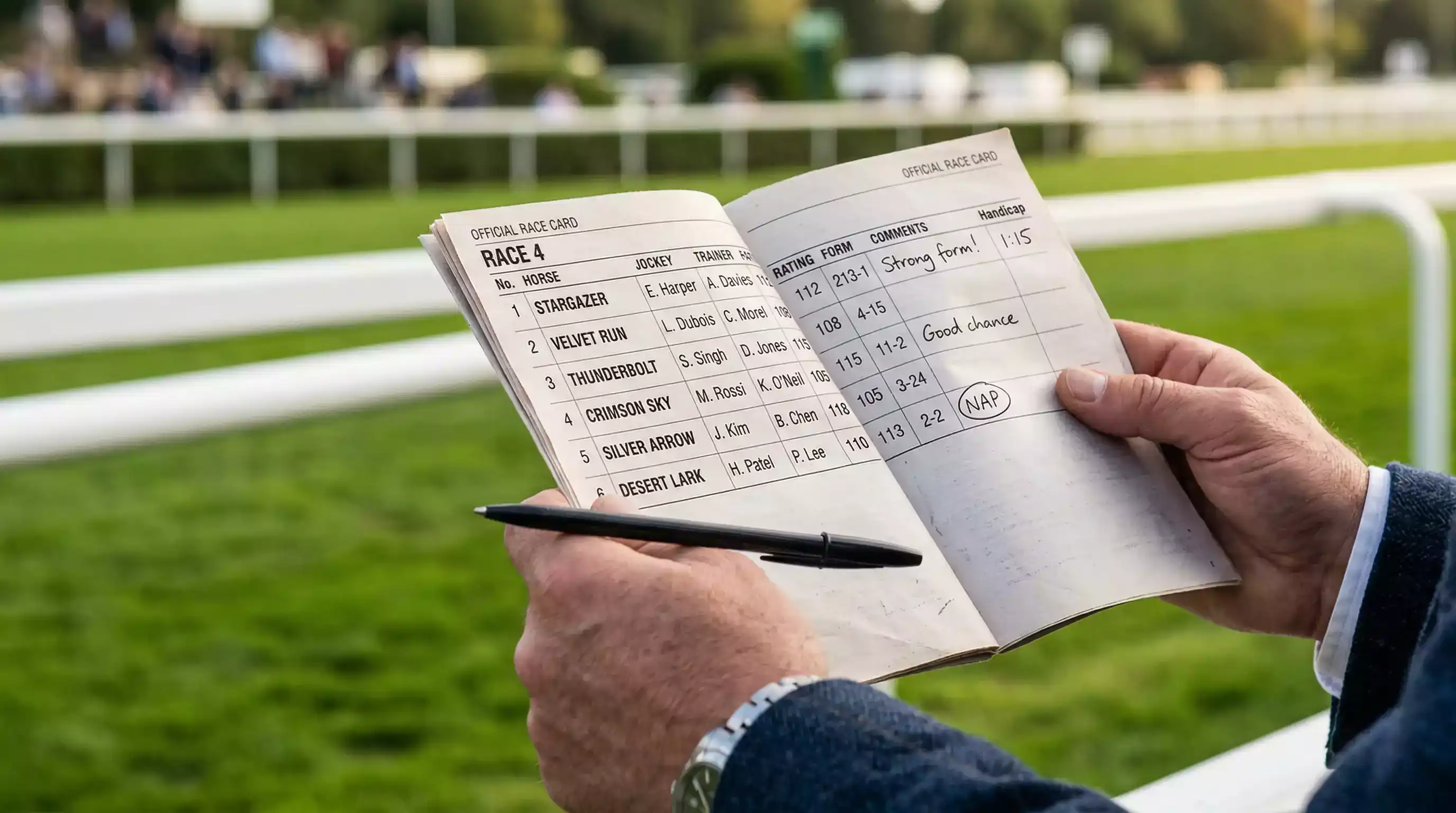
Table of Contents
- The Racecard Is Your Cheat Sheet — Here’s How to Use It
- Anatomy of a UK Racecard: Every Field Decoded
- Form Figures: What the Numbers and Letters Mean
- Going and Ground Conditions: How Terrain Changes Everything
- Class, Ratings and Handicap Marks
- Trainer and Jockey Stats Worth Checking
- A 60-Second Racecard Assessment for Your First Bet
- Frequently Asked Questions
The Racecard Is Your Cheat Sheet — Here’s How to Use It
I spent my first two years betting on horse racing without ever properly reading a racecard. I’d look at the horse’s name, glance at the odds, maybe check if the jockey sounded familiar, and place the bet. The results were about what you’d expect — random. I was treating a sport built on data like a lottery.
The racecard is the single most information-dense document in sport. Every runner’s recent results, weight carried, going preference, trainer form, jockey booking and official rating are compressed into a few lines of numbers, letters and abbreviations. BHA research from Project Beacon found that complexity of terminology ranks among the top barriers stopping new audiences from engaging with racing — and the racecard is where that complexity concentrates. People look at a wall of numbers like 1321-4F and assume it requires years of experience to decode.
It doesn’t. Every element on a racecard follows a consistent logic, and once you understand the system, the information reads as clearly as a football league table. This guide decodes every field you’ll encounter on a standard UK racecard, explains what matters and what you can safely ignore, and gives you a 60-second assessment process you can use before placing any bet.
Anatomy of a UK Racecard: Every Field Decoded
Pull up any racecard on a betting site or in the Racing Post and you’ll see the same core fields repeated for every runner. The layout varies by publisher, but the data is standardised across the industry. Here’s what each element means.
Draw number. In flat races, this is the stall position the horse starts from. Draw biases exist at specific courses — some tracks favour low draws, others favour high. In National Hunt races, there is no draw because horses don’t start from stalls. If you see a number in brackets next to the horse’s name on a flat racecard, that’s the draw.
Silks. The coloured jacket and cap the jockey wears, registered to the horse’s owner. Useful for identifying horses during the race but irrelevant to your betting analysis.
Horse name, age and sex. The name is obvious. The age matters because horses develop at different rates — a three-year-old taking on older horses is often at a disadvantage, though a talented one can overcome it. Sex is noted as C (colt), F (filly), G (gelding), M (mare) or H (horse, meaning an ungelded male aged five or older).
Weight. Expressed in stones and pounds (e.g. 11-4 means 11 stone 4 pounds). In handicaps, this is the weight the handicapper has assigned based on the horse’s rating. In non-handicap races, weight is determined by age and sex allowances. A horse carrying less weight has a physical advantage, all else being equal. The weight includes the jockey, saddle and equipment.
Headgear. Abbreviations like b (blinkers), v (visor), t (tongue-tie), h (hood), e/s (eye shield). These are equipment changes designed to improve concentration or breathing. First-time headgear is often flagged with a “1” and is considered a significant form indicator — trainers fit blinkers for the first time when they believe the horse needs help focusing, and the effect can be dramatic in either direction.
Trainer and jockey. Listed by name. Some racecards include recent strike rates — the percentage of runners that have won in the last 14 days. A trainer sending a 33/1 outsider with a 30% strike rate in the current period is a stronger signal than the same horse from a trainer running at 5%.
Form figures. The string of numbers and letters that tells you how the horse has performed recently. This is important enough to warrant its own section, which follows below.
Official Rating (OR). A number assigned by the BHA handicapper reflecting the horse’s assessed ability. Higher numbers mean better horses. In handicaps, this number directly determines how much weight the horse carries. In non-handicaps, it gives you a way to compare ability across different race classes.
Days since last run. Some racecards show this explicitly. A horse returning from a long absence (60+ days) might need the run to reach peak fitness. A horse running for the third time in two weeks might be feeling the effects of a busy schedule. Both extremes are worth noting.
Race conditions. At the top of each racecard, you’ll find the race title, class, distance, going, prize money and age restrictions. These set the parameters for everything below. A Class 4 handicap over a mile on good-to-soft ground for four-year-olds and above is a very different contest from a Class 1 novice hurdle over two miles on heavy ground. Always read the race conditions first — they tell you what kind of form is relevant and which horses are likely to be suited.
The volume of information can feel paralysing at first glance. Don’t try to process every field for every runner. Start with the three or four horses at the top of the betting market and read their data carefully. Compare them against each other. Then scan the rest of the field for anything that stands out — an interesting form figure, a course-and-distance winner, a notable jockey switch. This selective approach gets you 80% of the way to an informed bet in a fraction of the time a full analysis would take.
Form Figures: What the Numbers and Letters Mean
A string of characters like 21P3-14 looks like a password. It’s actually a complete performance history, read from right to left, with the most recent run on the far right. Each character represents one race. The numbers show finishing position, and the letters carry specific meanings.
The number system is straightforward: 1 means the horse won, 2 means second, 3 means third, and so on up to 9. A 0 means the horse finished tenth or worse — lumped into a single digit because at that point the exact position matters less than the fact it was well beaten. The dash (-) separates the current season from the previous season or marks a break in racing. So 21P3-14 reads as: last season the horse won then finished fourth; this season it pulled up, finished third, finished first, then finished second in its most recent run.
The letter codes add critical context:
- F — fell (the horse hit the ground, National Hunt only)
- U — unseated rider (the jockey came off, but the horse didn’t fall)
- P — pulled up (the jockey stopped the horse during the race, usually due to fatigue or injury)
- R — refused (the horse refused to jump a fence or start)
- B — brought down (fell because another horse fell into it)
- C — carried out (forced off the course by another runner)
- D — disqualified
Next to the horse’s name on many racecards, you’ll also see course and distance indicators. A “C” means the horse has won at this specific course before — it knows the track, the undulations, the bends. A “D” means it has won at today’s distance. “CD” means both. These are shorthand for proven ability in today’s conditions, and they carry real weight in my selection process. A horse that’s won twice at Cheltenham over two and a half miles and is returning to the same course and distance has a track record you can trust — literally.
Reading form figures takes practice, but the skill develops fast. After a couple of weeks of checking every runner’s form before betting, you’ll start recognising patterns: the horse that’s been running consistently in the first four but hasn’t won (ripe for a breakthrough), the horse whose form reads P-U-F (stay away), the horse dropping in class after solid placed efforts at a higher level (interesting). Form is the single most predictive data point on the racecard, and it’s available for free on every betting site in the country.
One pattern I look for specifically: the form figure “2” appearing multiple times in recent runs. A horse that keeps finishing second is telling you it’s competitive enough to be in the mix but hasn’t had the right combination of circumstances to win. When something changes in its favour — a drop in class, a switch to preferred going, a more prominent jockey booking — that serial placer can turn into a winner at a decent price. The market often undervalues consistency because punters fixate on winners and overlook horses that are running well without crossing the line first.
Another detail worth noting: the weight of each past performance. A horse that finished third carrying 10 stone 2 pounds last time and now runs off 9 stone 10 pounds has a 6-pound advantage it didn’t have before. Weight changes between runs are listed on detailed racecards and can turn a near-miss into a winning performance. It’s one of the subtleties that separates informed punters from casual ones.
Going and Ground Conditions: How Terrain Changes Everything
A horse that loves soft ground and turns up on a firm track is like a distance runner competing in sand. It might still perform, but everything is harder. Going — the official assessment of ground conditions — is one of the most underrated factors in beginner betting, and ignoring it has cost me more money than any other single mistake. Racecourse attendance topped 5.031 million in 2025, the first time the figure exceeded 5 million since 2019, and a significant share of those attendees discovered firsthand how a morning downpour can reshape an entire card.
The going scale in the UK runs from hard (rare, only on all-weather surfaces in summer) through firm, good-to-firm, good, good-to-soft, soft, and heavy. National Hunt racing tends towards the softer end because it runs primarily in autumn and winter when the ground is naturally wetter. Flat racing spans the full range depending on season and location. The official going is declared by the clerk of the course, sometimes updated multiple times on race day as weather conditions change.
Every horse has going preferences, and they show up clearly in the form. Look for form figures achieved on similar ground to today’s conditions. A horse with form reading 1-2-1 on soft ground and 7-6-8 on good-to-firm is telling you something unmistakable about where it performs best. Racecards often note the going for each past run alongside the form figure, which lets you filter for relevant performances.
Where going catches beginners out is in the gap between the published forecast and reality. The going can be declared as “good” at 8am and change to “good-to-soft” by the third race if a rain shower hits. If your selection specifically needs fast ground, a mid-afternoon downpour can transform the race from a near-certainty to a struggle. I check the weather forecast for the racecourse area — not just the national forecast — every time I bet, and I treat rain as a form factor just as important as any number on the card. For a deeper look at how ground conditions interact with form, I’ve written a separate guide to going in horse racing.
Class, Ratings and Handicap Marks
Not every race is created equal, and neither is every piece of form. A horse that finished fourth in a Class 2 handicap at York is likely a better animal than one that won a Class 6 maiden at a Monday evening meeting. The class system structures UK racing into tiers, and understanding where a race sits in that hierarchy completely changes how you interpret the form figures.
British racing runs from Class 7 at the bottom to Class 1 at the top, with Group races (Group 3, Group 2, Group 1) and Listed races occupying the elite tier above Class 1 handicaps. Total prize money across British racing reached a record 194.7 million pounds in 2025, but it’s distributed unevenly — a Group 1 race at Royal Ascot might carry a purse of several hundred thousand pounds, while a Class 6 contest at a smaller track might offer a few thousand. Prize money reflects quality, and quality reflects the calibre of horse you’re assessing.
The Official Rating (OR) is the numeric expression of class. A horse rated 105 is significantly more talented than one rated 65. In handicap races, the rating determines the weight the horse carries — higher-rated horses carry more weight, which in theory equalises the field. When a horse drops in class — say, from a Class 3 to a Class 4 — its rating might be at the higher end of the new class range, giving it a theoretical advantage over horses rated lower. This is what commentators mean when they say a horse is “well in at the weights” or “has dropped to a winning mark.”
For betting purposes, the most important class-related question is whether a horse is running at, above or below its proven ability level. A horse that has been competing in Class 2 company and drops to Class 3 is likely to be more competitive — it’s been tested against better opposition. A horse stepping up from Class 5 to Class 3 for the first time is an unknown quantity at the higher level. Look at where the form was achieved, not just the figures themselves.
Trainer and Jockey Stats Worth Checking
There’s a trainer in the north of England whose horses I’ve tracked for years. When this yard sends a runner to a course 200 miles from home, it usually means business — the travel cost alone suggests confidence. That kind of pattern is invisible if you only look at the horse. The trainer-jockey combination adds a layer of information that the racecard distils into a few names and numbers.
Trainer strike rate — the percentage of winners from total runners over a given period — is the most useful single stat. A strike rate of 20% or higher in the current season signals a yard in form, regardless of individual horse quality. Conversely, a big-name trainer running at 6% might be going through a cold spell, a virus in the yard, or a transitional period. The BHA chief executive Brant Dunshea has spoken about British racing having two of the top five horses in the world and the best jockeys in the world — that talent is real, but it’s concentrated in certain yards, and identifying which yards are firing is worth more than following names alone.
Jockey bookings carry their own signals. When a champion jockey chooses to ride a 10/1 shot over a 3/1 favourite from the same stable, that tells you something about the yard’s private expectations. When an in-demand jockey picks up a spare ride at the last minute, it might indicate the horse’s regular rider saw something in the morning that caused a switch. These micro-signals are speculative individually but meaningful in aggregate.
The trainer-jockey combination is particularly telling. Some jockeys have notably better records for certain trainers. Some trainers always book the same rider when they fancy a horse’s chances. Racecards on the major form sites now show these combination stats, and a trainer-jockey partnership winning at 30% when the overall trainer strike rate is 15% is a data point worth incorporating into your assessment.
A 60-Second Racecard Assessment for Your First Bet
Project Beacon identified an addressable audience of over 25 million potential racing fans in the UK, most of whom have minimal or no current contact with the sport. If you’re in that group and the racecard still feels overwhelming, here’s the stripped-down process I’d use to assess a race in under a minute. It’s not comprehensive — a full analysis takes longer — but it’s enough to make a reasoned bet rather than a random one.
First, read the form from right to left. Focus on the last three runs. You want horses that have been finishing in the first four — numbers 1, 2, 3 or 4 on the right side of the form string. Ignore anything that happened before the seasonal break (the dash). A horse showing 1-2-3 in its last three runs is in consistent form. One showing 8-P-7 is not.
Second, check the going. Match today’s conditions against where the horse has performed well before. If it’s soft ground today and the horse’s best form came on soft, that’s a positive. If all its wins were on good-to-firm and the ground is heavy, move on.
Third, look for C and D flags. A horse returning to a course it’s won at before (C) and running over a proven distance (D) has two built-in advantages. Neither guarantees anything, but they tilt probability in a measurable way.
Fourth, glance at the trainer strike rate. If the yard is running at 18% or above in the last 14 days, the horse comes from a confident operation. If the strike rate is in single digits, temper your expectations.
That’s four checks: recent form, going suitability, course-and-distance record, and trainer form. Sixty seconds, maybe ninety if you’re new to it. You won’t win every bet using this process, but you’ll be making decisions based on evidence rather than instinct, and over time that difference compounds. As you get more comfortable, you can layer in additional analysis — speed ratings, draw biases, headgear changes — but these four form the backbone that everything else builds on.
Frequently Asked Questions
What does a C or D next to a horse’s name mean on a racecard?
C means the horse has previously won at today’s racecourse. D means it has won at today’s race distance. CD means it has won at both the same course and distance. These indicators show proven ability in conditions matching today’s race.
How do I know if a horse suits today’s going?
Check the horse’s past form alongside the going description for each previous run. Most detailed racecards show the going conditions next to each form figure. Look for wins or strong placings on ground similar to today’s official going declaration. A horse with multiple wins on soft ground is likely to handle soft conditions again.
What is the difference between Official Rating and topspeed rating?
The Official Rating is assigned by the BHA handicapper and directly determines the weight a horse carries in handicap races. It reflects overall assessed ability. Topspeed and other speed ratings are produced by independent analysts and measure how fast a horse has run relative to standard times. Both are useful but serve different purposes — OR determines handicap conditions, while speed ratings help compare performances across different meetings.
Prepared by the First bet Horse Racing editorial staff.