
Horse Racing Non-Runner Rules: Refunds, Rule 4 Deductions and What Happens to Your Bet
 Available in US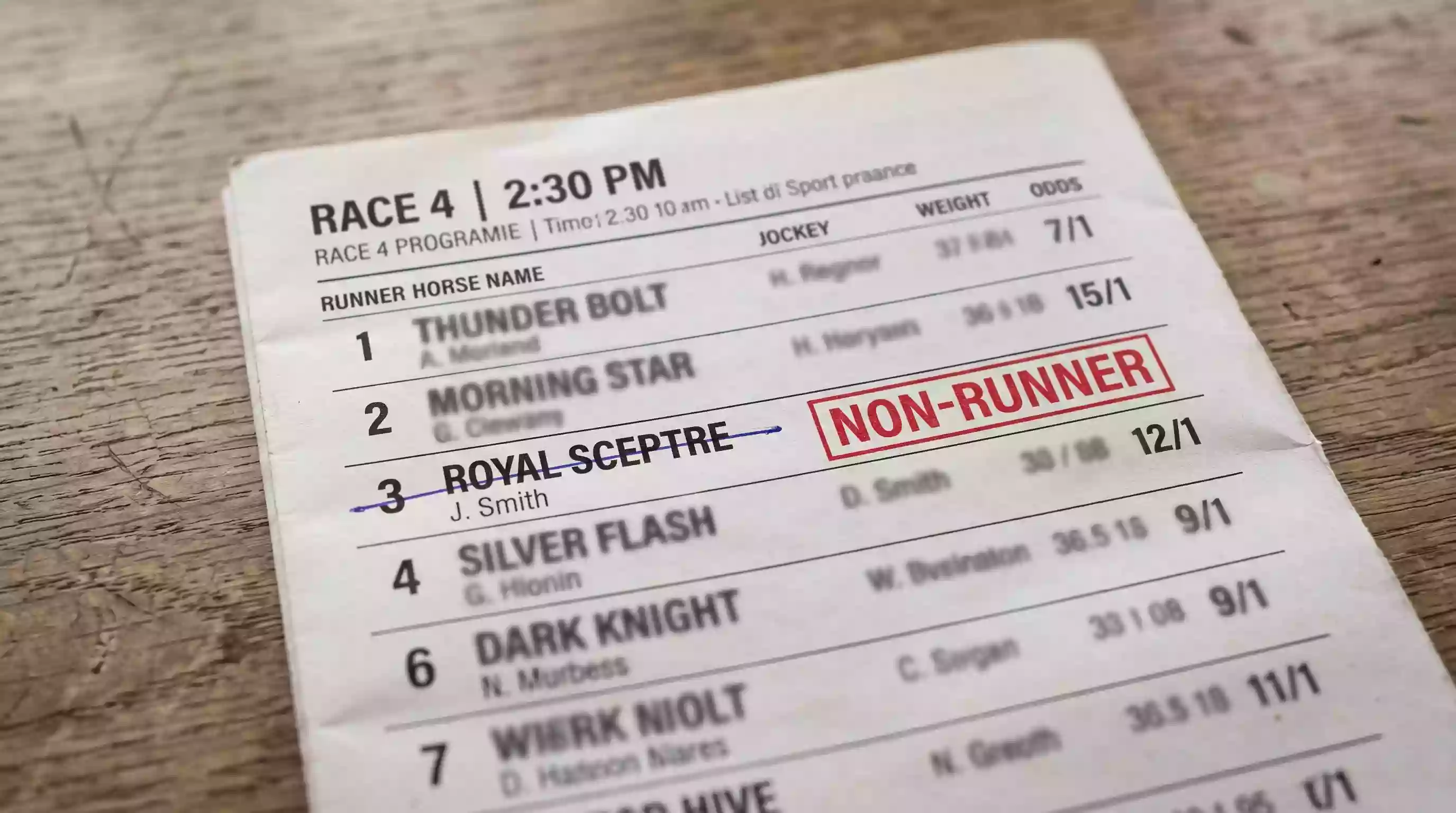
Your Horse Is Out — Now What Happens to Your Money?
It happened to me at Cheltenham. I had studied the card for an hour, narrowed down to a strong fancy in the third race, placed my bet at a price I was thrilled with, and sat back to watch. Ten minutes before the off, the announcement came through: non-runner. My horse had been withdrawn. The immediate question — the one every beginner asks — is simple: do I get my money back?
The answer depends entirely on the type of bet you placed and when you placed it. Non-runner rules are one of the least-understood aspects of horse racing betting, and they catch more beginners off guard than bad form analysis ever does. There are three distinct scenarios: a straightforward refund, a deduction under Rule 4, and the harshest outcome — no refund at all.
Standard Non-Runner Refund: When You Get Your Stake Back
If you placed a single win or each-way bet at fixed odds on a horse that is subsequently declared a non-runner, the standard outcome is a full refund of your stake. This is the simplest and most common scenario. Your money is returned to your account, and the bet is void as if it never happened.
The refund applies to bets placed on the day of the race or close to it — what the industry calls “day-of-race” or “board price” bets. It also covers bets taken at early prices on the morning of racing, provided the bookmaker’s terms cover non-runner refunds on early-price bets, which virtually all major UK operators do.
For multiple bets — accumulators, doubles, trebles — a non-runner does not void the entire bet. Instead, the non-runner leg is removed and the bet is recalculated as a smaller multiple. A four-fold accumulator with one non-runner becomes a treble. A double with one non-runner becomes a single on the remaining selection. Your potential return decreases because the multiplication effect is reduced, but the bet remains live.
Overall betting turnover on British horse racing dropped 9 percent in Q1 2025, and non-runners contribute to bettor frustration, particularly during the National Hunt season when ground conditions change rapidly and last-minute withdrawals are common. Knowing that a refund is the default outcome for day-of-race bets removes at least some of that anxiety.
Rule 4 Deductions: How They Work and What You’ll Lose
Here is where it gets less straightforward. When a horse is withdrawn from a race after the market has formed but before the race starts, the remaining runners effectively have a better chance of winning. The odds on those runners should, in theory, shorten to reflect the reduced field. But your bet was placed at the original, longer price. Rule 4 exists to correct that imbalance.
A Rule 4 deduction is a percentage reduction applied to your winnings — not your stake, your winnings — to account for the removal of a runner. The size of the deduction depends on the odds of the withdrawn horse at the time of withdrawal. If the non-runner was the favourite at 2/1, the deduction is substantial — typically 30 pence in the pound. If it was a 33/1 outsider, the deduction is minimal — perhaps 5 pence in the pound. The shorter the withdrawn horse’s odds, the greater the impact on the remaining market, and the higher the deduction.
The deduction scale is standardised across the industry. At even money (1/1), the deduction is 45 pence in the pound. At 3/1, it is 20 pence. At 10/1, it is 5 pence. At 14/1 or longer, the deduction is zero — the outsider’s removal is deemed not to have materially altered the market.
Crucially, Rule 4 applies to all bets on the remaining runners in that race, not just to bets on the non-runner. If you backed a different horse and the favourite was withdrawn, your winning payout will be reduced by the applicable Rule 4 deduction. This surprises many first-time bettors who assumed the deduction only affected people who backed the withdrawn horse.
Ante-Post Exception: No Refunds, No Rule 4
Ante-post betting operates under entirely different rules. Around 250 million pounds is wagered annually on the Grand National alone, and a meaningful portion of that comes through ante-post markets that open months in advance. The prices are better because you are absorbing a specific risk: if the horse does not run, you lose your stake. Full stop.
There are no refunds on ante-post bets for non-runners. There are no Rule 4 deductions either. The reason is that ante-post odds already factor in the possibility of withdrawal. The price is longer precisely because the risk is higher. You are being compensated upfront for accepting that the horse might never make it to the start.
For beginners, this distinction is critical. If you are placing a bet on a horse for the Cheltenham Festival in November and the horse gets injured in February, your stake is gone. There is no mechanism to recover it. Some bookmakers offer “non-runner, no bet” promotions on specific ante-post markets, which provide the ante-post price with a refund guarantee if the horse is withdrawn. These promotions are valuable and worth seeking out if you want early prices without the full ante-post risk.
How Non-Runners Affect Each-Way and Accumulator Bets
Non-runners interact with each-way bets in a way that is not immediately obvious. If withdrawals reduce the field size below a place-term threshold — from eight runners to seven, for instance — the number of paying places drops from three to two. Your each-way bet was placed with three places in mind, but you are now getting only two. The place part of your bet is recalculated to reflect the reduced field.
In accumulator bets, the non-runner leg is voided and the bet is restructured. A five-fold becomes a four-fold. The bet still runs, but the payout is lower because one multiplication is removed. If two legs are non-runners in a four-fold, you are left with a double. If all but one leg are voided, you have a single. The bet never becomes void entirely unless every selection is a non-runner.
My practical advice: always check the morning declarations and any late changes before the first race. Non-runners can be announced at any point up to the race, but most are declared by the morning of the meeting. If you placed a bet the night before, confirm that your horse is still running. A two-minute check can save you from watching a race with money on a horse that is not in it.
For a deeper understanding of how each-way place terms work and how non-runners can shift them, the each-way betting guide covers the mechanics in full.
How is the Rule 4 deduction percentage calculated?
The deduction is based on the odds of the withdrawn horse at the time it was removed from the race. Shorter-priced withdrawals trigger larger deductions because their removal has a greater impact on the market. At even money, the deduction is 45 pence in the pound. At 3/1, it is 20 pence. At 10/1, it is 5 pence. At odds of 14/1 or longer, no deduction applies. The scale is standardised across UK bookmakers.
Do I get a refund on a Lucky 15 if one horse is a non-runner?
The non-runner leg is voided, and the bet is recalculated. A Lucky 15 has 15 individual bets across four selections. If one selection is a non-runner, the bets involving that selection are voided and your stake on those specific bets is returned. The remaining bets — those involving only the three active selections — continue as normal, effectively becoming a Patent (7 bets on 3 selections).
Prepared by the First bet Horse Racing editorial staff.