Horse Racing Betting Psychology: Cognitive Biases That Cost Punters Money
 Available in US
Your Worst Enemy at the Racetrack Isn’t the Bookmaker
I once lost four consecutive bets on a Saturday afternoon at Sandown. Not large amounts — five or ten pounds each — but by the fifth race, I was angry. Not at the horses, not at the bookmaker, but at the universe for being fundamentally unfair. So I tripled my stake on the last race, backing a horse I had barely studied, because I “deserved” a winner. It lost. The afternoon cost me twice what it should have because of a decision made by my emotions, not my analysis.
Survey data from the Gambling Commission shows that 42 percent of UK bettors rate their experience positively and another 35 percent rate it neutrally. Those are encouraging numbers. But they mask the reality that even satisfied bettors make systematic errors in judgement — errors that have nothing to do with knowledge and everything to do with how human brains process risk, reward, and loss. Understanding these errors does not eliminate them, but it makes them visible, which is the first step towards managing them.
The Gambler’s Fallacy: Why “Due to Win” Is a Myth
After backing three losing favourites in a row, the thought is irresistible: the next one has to win. The pattern has to break. The universe owes me a winner. This is the gambler’s fallacy — the belief that past outcomes influence future probabilities in independent events. Each race is a separate event. The result of the 2:30 at Kempton has zero bearing on the outcome of the 3:05. The favourite in the next race has the same probability of winning whether the last three favourites won or lost. The dice have no memory.
The fallacy is seductive because human brains are pattern-recognition machines. We evolved to find patterns even where none exist, because in most areas of life, patterns are real — seasons repeat, predators follow prey trails, cause follows effect. Betting is one of the few environments where each event is genuinely independent, and our instinct to find patterns actively works against us.
The practical cost is real. Bettors influenced by the fallacy increase their stakes after a losing streak, believing a correction is imminent. Or they avoid backing a horse that fits their analysis because “favourites have been winning all day and one has to lose.” Both responses distort rational decision-making. The question for every bet should be: does this horse offer value at this price, right now? The answer to the last five races is irrelevant.
Chasing Losses: The Spiral That Breaks Bankrolls
Seven percent of UK adults bet on horse racing during the festival season, dropping to four percent outside peak months. Within that population, chasing losses is the single most destructive behaviour — more damaging than poor form analysis, bad odds, or any other technical mistake.
Chasing losses is what I did at Sandown: increasing stakes after a losing run to try to recover the deficit. The logic feels sound in the moment. “If I bet bigger on the next race and win, I get everything back.” The problem is that you are now making decisions under emotional pressure, with a larger stake, on a selection you may not have chosen under normal circumstances. The probability of winning has not changed. The potential damage of losing has doubled or tripled.
Loss aversion — a well-documented psychological phenomenon — explains why chasing is so compulsive. Losing 20 pounds feels roughly twice as painful as winning 20 pounds feels good. That asymmetry drives us to take disproportionate risks to avoid the pain of crystallising a loss. We would rather gamble on recovering it than accept it and walk away. This is not a character flaw. It is a feature of human cognition that applies to almost everyone, from novice punters to city traders.
The defence is structural, not mental. Set a daily loss limit before you start betting. When you hit it, stop. Not “stop after the next race” — stop immediately. The limit should be an amount you can lose without it affecting your week. If you find yourself unable to stop when you hit the limit, that is important information about your relationship with betting that deserves serious reflection.
Confirmation Bias: Seeing Winners That Aren’t There
I once spent thirty minutes convincing myself to back a horse that I had already decided to back before I opened the racecard. I found the form that supported my view and ignored the form that contradicted it. The horse had won two of its last three starts — excellent. It had also moved up two classes, the going was against it, and the jockey had a poor record at the course — details I glossed over because they did not fit the story I had already written.
Confirmation bias is the tendency to seek, interpret, and remember information that confirms what we already believe. In horse racing, it manifests as selective form reading. You notice the positives about a horse you fancy and downplay the negatives. You remember your winning tips and forget the losers. You attribute wins to skill and losses to bad luck.
The antidote is to argue against your own selection. After identifying a horse you want to back, spend two minutes actively looking for reasons it might lose. What does its form look like on today’s going? Has it been raised in class? Is the pace likely to suit its running style? If the case against is stronger than the case for, put the bet down and move on. This exercise feels unnatural — nobody enjoys undermining their own conviction — but it is the single most effective quality-control step you can add to your betting process.
Mental Defences: How to Bet With Clarity
Knowing about biases is useful. Having systems that counteract them is better. Over nine years, I have settled on four practices that keep my betting rational when my emotions want to take over.
First, I decide my selections and stakes before the first race of the day. Once the decisions are made, I do not change them based on what happens in earlier races. Good results do not make me more aggressive. Bad results do not make me chase. The plan was made with a clear head; I trust the clear-headed version of myself over the emotional in-the-moment version.
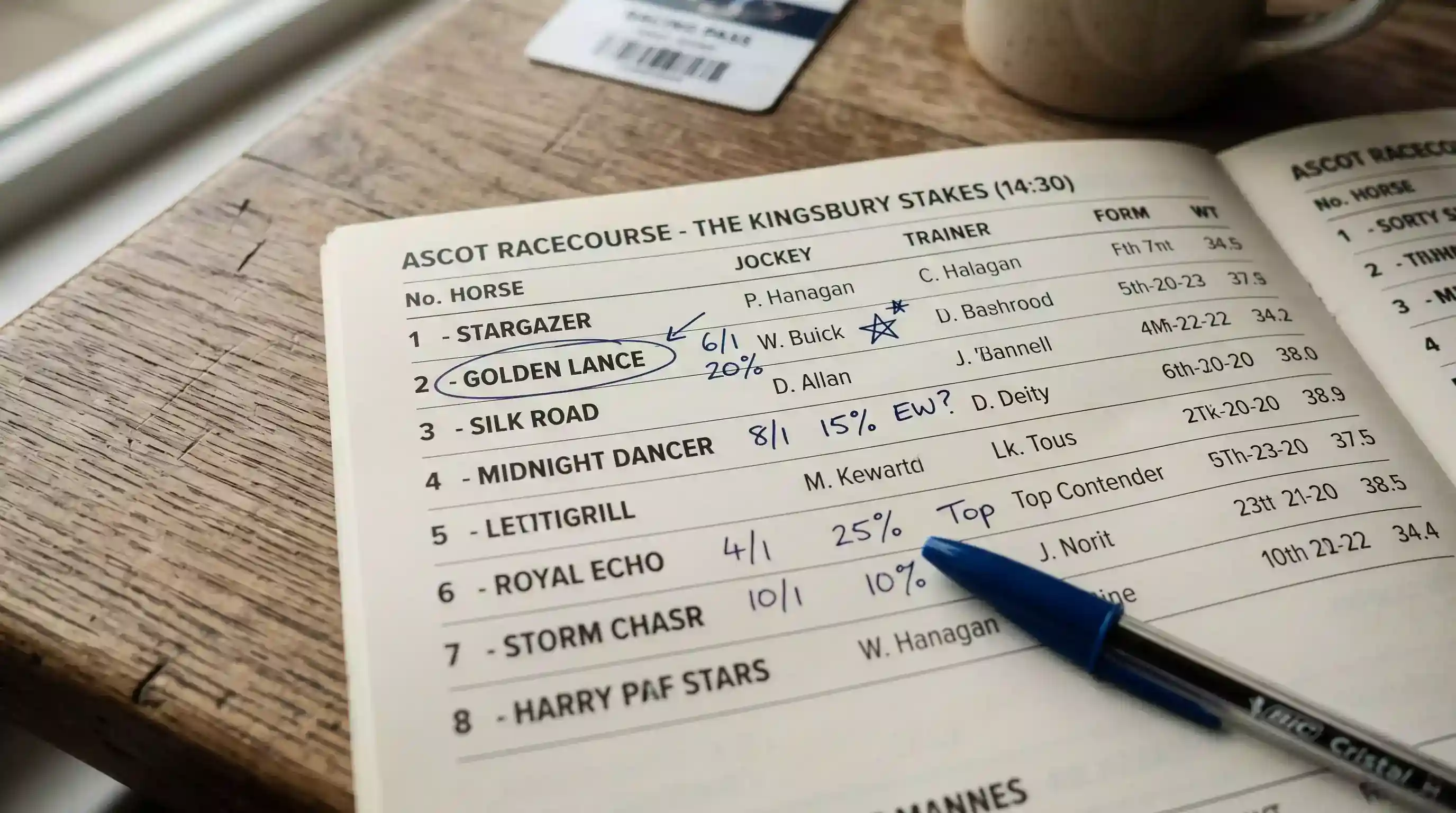
Second, I record every bet in a spreadsheet. Not just the winners — every single bet, including the reasoning. Over time, the spreadsheet reveals patterns that my memory distorts. I can see whether my win rate matches my perception, whether I actually make money on favourites or only think I do, and whether my stake sizes are consistent or creeping upward after losses.
Third, I take breaks. If I am feeling frustrated, bored, or reckless, I close the app or leave the ring. Betting under emotional influence is not betting — it is reacting. Five minutes away from the screen is usually enough to reset.
Fourth, I treat every race as independent. The last result does not predict the next result. My recent performance does not change the probability of any future bet winning. This is the hardest habit to internalise, because our brains are wired to connect events in sequences. In racing, the sequences are an illusion.
For a structured framework on managing stakes and setting loss limits that support these mental defences, the bankroll management guide covers the practical mechanics.
How do I tell the difference between a legitimate trend and the gambler’s fallacy?
A legitimate trend is based on a causal relationship — for example, a trainer’s horses consistently performing well at a specific track because the training facilities nearby suit their preparation. The gambler’s fallacy is the belief that random outcomes will self-correct — for example, assuming the next favourite must win because the last three favourites lost. If you can identify a plausible reason why the pattern exists beyond pure chance, it may be a genuine trend. If the reasoning boils down to ‘it is due to happen,’ that is the fallacy.
Is it normal to feel compelled to bet again after a loss?
Yes. Loss aversion — the psychological tendency to feel losses more intensely than equivalent gains — is a well-documented feature of human cognition. The urge to bet again after a loss, particularly at higher stakes, is a natural response to that discomfort. Recognising the urge is not the same as acting on it. Setting pre-determined loss limits and sticking to them is the most effective way to manage this impulse without relying on willpower alone.
Written by the editors at First bet Horse Racing.