Horse Racing In-Play Betting: How Live Odds Work and When to Bet In-Running
 Available in US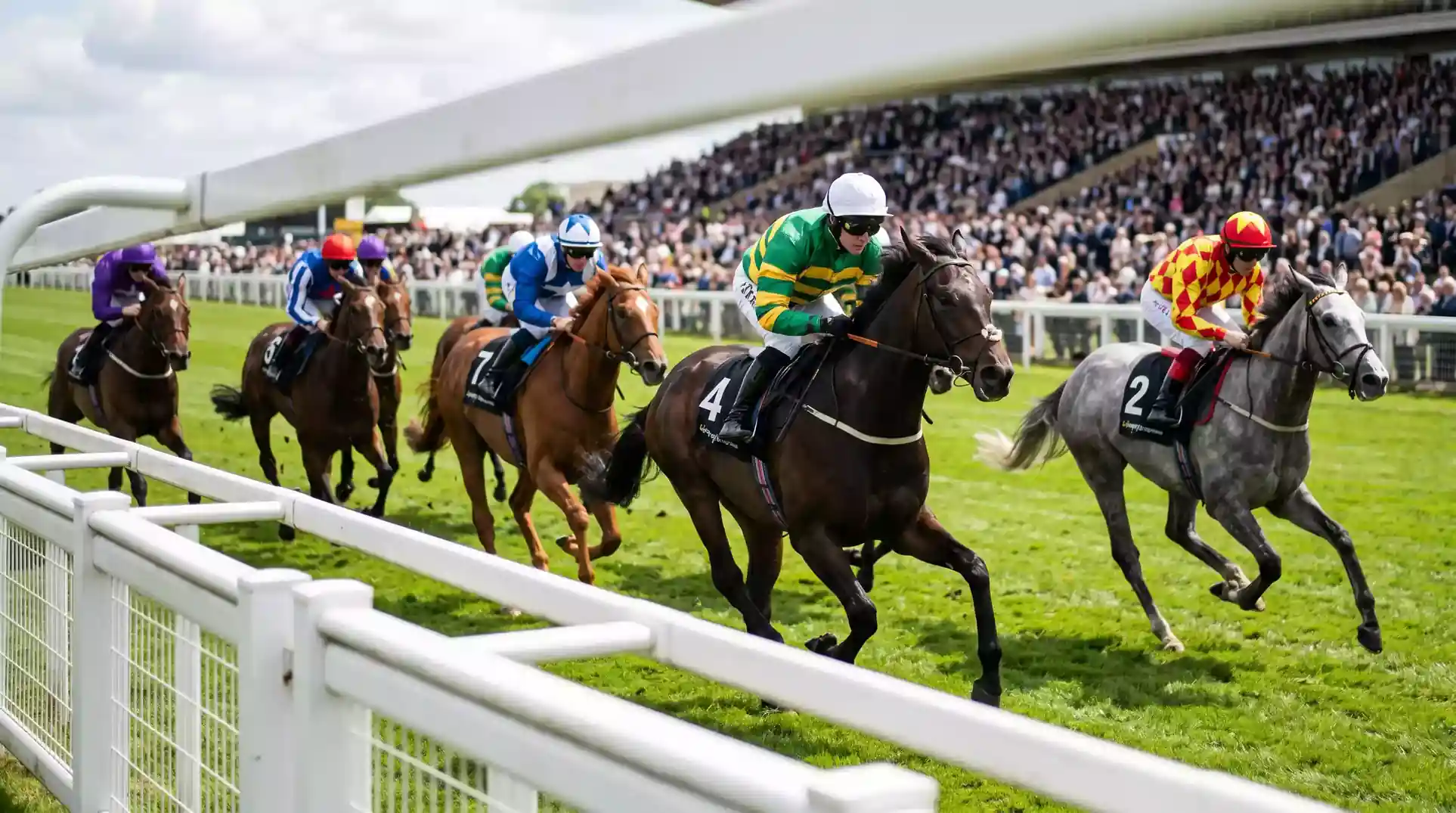
Betting After the Off: Why In-Play Is Growing — and Why It’s Risky
The first time I bet in-play on a horse race, it was over before I finished tapping the screen. I saw my horse take the lead at the two-furlong pole, scrambled to back it at the new shorter price, and by the time the bet was confirmed the horse had already been passed by the eventual winner. The entire exercise took about eight seconds and taught me more about in-play betting than a month of reading ever could.
The UK remote casino, betting, and bingo sector generated 7.8 billion pounds in gross gaming revenue in the 2024-25 financial year — a 13.1 percent rise year on year. In-play betting across all sports is a significant driver of that growth. Horse racing in-play markets move faster than any other sport because races are short — two minutes for a flat race, four or five for a long-distance chase — and the odds shift with every stride.
How In-Running Markets Work on Bookmakers and Exchanges
With 24.4 million active online betting accounts in the UK, a growing proportion of racing bets are placed after the start. The mechanics differ between bookmakers and exchanges, and that difference matters.
On a traditional bookmaker’s app, in-play horse racing markets offer prices that update automatically based on algorithms. The odds shorten on horses that are travelling well and lengthen on those losing ground. You tap a selection, enter a stake, and the app either accepts or rejects the bet depending on whether the price has changed since you tapped. Rejections are common because the market moves faster than human reaction time. Many bookmakers offer a “price change acceptance” setting that automatically places your bet at the new price within a tolerance range — this reduces rejections but means you might get worse odds than you intended.
On exchanges, in-play markets are driven entirely by other bettors. There is no algorithm setting prices — users place back and lay bets in real time, and the odds reflect the balance of money on each side. Exchange in-play tends to be more liquid on high-profile races (the Gold Cup, the Grand National) and thinner on smaller meetings. The advantage of exchange in-play is that you can lay as well as back — betting against a horse that you think is about to tire or fall — but the speed required to trade effectively is beyond what most casual users can manage.
Both environments share a critical characteristic: the information advantage lies with people who have the fastest data feeds. Professional in-play traders use technology that delivers race updates fractions of a second before bookmaker streams or TV broadcasts. They can react to events — a horse stumbling, a jockey making a move — before you even see it on your screen. This structural disadvantage makes in-play horse racing one of the hardest betting environments for a retail punter to profit from consistently.
Cash-Out During a Race: How It Works and What It Costs
Cash-out is in-play’s most popular feature for recreational bettors, and it is also the one most likely to cost you money over time. The principle is straightforward: at any point during a race, your bookmaker offers to settle your pre-race bet at a calculated value based on the current in-play odds. If your horse is leading, the cash-out value will be higher than your stake. If it is trailing, the value will be lower.
The catch is in the calculation. The cash-out offer always includes a margin for the bookmaker — typically 5 to 10 percent of the theoretical fair value. If the mathematically fair cash-out on your bet is 40 pounds, the bookmaker might offer you 36 or 37. That margin is the price of certainty. You are paying the bookmaker to remove the remaining risk.
I have a rule about cash-out that I rarely break: I only use it when the information has changed. If I backed a horse because I thought it would handle the ground and stay the trip, and it is travelling well at halfway, nothing has changed — I let the bet run. If the horse makes a bad mistake at a fence and nearly falls, something has changed — the risk of non-completion has increased, and cashing out to lock in a partial profit may be the correct decision.
What I never do is cash out purely because the cash-out button shows a green number. A green number means you are currently in profit, not that cashing out is the optimal decision. If your pre-race analysis was sound and nothing in the race has contradicted it, taking a reduced payout to eliminate the remaining risk is usually a poor trade. Over hundreds of bets, the bookmaker’s cash-out margin accumulates into a significant drag on your returns.
Why Most Beginners Should Watch, Not Bet, In-Play
I am nine years into this game, and I still rarely bet in-play on horse racing. The market moves too fast for considered decision-making. The structural disadvantage against faster data feeds is real and quantifiable. The emotional intensity of watching a race while your money is at stake — and having the option to bet more — creates precisely the conditions that lead to impulsive, poorly reasoned wagers.
For beginners, in-play is best treated as an observation tool rather than a betting opportunity. Watch how odds move during a race. Notice how a horse’s price shortens when it moves into a prominent position and lengthens when it loses ground. This visual education in real-time market behaviour is genuinely valuable for understanding how odds work — but you do not need to have money on the line to benefit from it.
If you do want to experiment with in-play, start with the smallest possible stakes. Treat it as a learning exercise, not a profit-generating activity. Set a separate, small budget for in-play betting that is distinct from your pre-race bankroll. And resist the urge to chase — the speed of in-play racing makes chasing losses even more dangerous than in pre-race markets.
For a thorough understanding of how odds move and what those movements signal, the odds explained guide covers the mechanics from first principles.
Can I cash out a horse racing bet mid-race?
Yes, if your bookmaker offers cash-out on horse racing. Most major UK operators provide this feature. The cash-out value is recalculated in real time based on the current in-play odds and always includes a bookmaker margin. Cash-out is not available on all bet types or all races — exchange bets, for example, are managed differently. Check whether cash-out is available before the race starts if you think you might want to use it.
Is in-play betting available on every UK race?
Most major UK bookmakers offer in-play markets on the majority of UK and Irish horse races. However, smaller meetings or races with very few runners may not have in-play markets. Exchange in-play tends to be available only on higher-profile races where there is sufficient liquidity. If in-play betting on a specific race is important to you, check your bookmaker’s coverage before the meeting starts.
Published by the First bet Horse Racing team.