Horse Racing Handicap Betting: How Weights Work and What to Watch For
 Available in US
The Great Equaliser: Why Handicaps Exist and Why Bettors Love Them
The first time I really understood handicap racing, I was watching a 16-runner sprint at Newmarket. The top weight was carrying 10 stone, the bottom weight 8 stone 5 pounds. That is a difference of 23 pounds — roughly the weight of a full rucksack. The handicapper had decided that this weight gap was the precise amount needed to give every horse in the field an equal theoretical chance. Whether the handicapper was right is what makes handicap betting the most intellectually engaging form of horse racing wagering.
Horse racing supports approximately 85,000 jobs in the UK, including over 20,000 at licensed racecourses. A significant share of the betting activity that sustains those jobs is generated by handicap races. They attract the biggest fields, the longest odds, the widest each-way place terms, and the most engaged betting public. Non-handicap races test which horse is the best. Handicaps test which horse is the best value — and that distinction is everything for punters.
How the Handicapper Allocates Weight
Every horse in Britain with sufficient racecourse experience is assigned an Official Rating by the BHA’s team of handicappers. That rating is a numerical expression of the horse’s assessed ability — the higher the number, the better the horse. In a handicap race, the highest-rated horse carries the most weight, and every pound below that top weight corresponds to one rating point lower.
Prize money across British racing reached a record 194.7 million pounds in 2025, and handicap races account for the lion’s share of competitive fixtures. The handicapper uses race results, margins of victory and defeat, and the ratings of horses that finished around each runner to adjust ratings after every performance. Win by five lengths and your rating goes up. Finish 10 lengths behind the winner in a higher-class race and your rating might stay the same or drop slightly.
This dynamic is crucial for betting. A horse’s Official Rating is not fixed — it moves after every run. A horse that wins impressively will be raised by the handicapper, meaning it carries more weight next time. That weight increase might be enough to prevent it from winning again. Conversely, a horse on a losing run may see its rating drop to a level where it becomes competitive again. The handicapper’s job is to keep recalibrating so that every race is genuinely open.
The weight range in most handicaps is between 8 stone and 10 stone on the flat, and 10 stone to 12 stone over jumps. The maximum spread is typically around 2 stone (28 pounds), but not all races use the full range. Some races have narrower bands, creating a more tightly compressed field where the differences between runners are smaller and the results are harder to predict.
Spotting a Well-Handicapped Horse
Brant Dunshea, the BHA’s Chief Executive, has described British racing as the second most-attended sport in the country, with two of the top five horses in the world and the best jockeys in the world. That depth of quality means the handicapper’s task is formidable — and occasionally, a horse slips through the system at a rating that underestimates its ability.
A “well-handicapped” horse is one whose current rating does not fully reflect its talent. This can happen for several reasons. The horse may have been running in unsuitable conditions — wrong ground, wrong trip, wrong class — and producing form below its true level. The handicapper can only rate what is visible in race results, not what a horse is capable of under ideal conditions. When a well-handicapped horse finally encounters its preferred conditions, it can win off a rating that makes it look like an outsider to the market.
Other indicators of a well-handicapped runner include a recent stable switch (a new trainer may improve the horse significantly), the application of first-time headgear (blinkers or a visor can transform a lazy horse), or a long absence followed by a return with a lower rating. Horses also become well-handicapped when they improve with age or maturity — particularly younger National Hunt horses that strengthen physically over the summer and return in autumn as better animals running off the same mark.
The market is not blind to these factors. Professional punters and analysts identify well-handicapped horses before most casual bettors do, which is why you sometimes see a 12/1 shot shorten to 7/1 before the off. The price movement tells you that informed money has spotted the angle. If your own analysis agrees, the shortening price is confirmation rather than a reason to avoid the bet.
Beginner Handicap Strategies: Three Things to Check
After years of dissecting handicap races, I have simplified my pre-race checklist to three questions that apply to every handicap, regardless of code, distance, or track.
First: is the horse well-in at the weights? Look at its recent form and ask whether the rating seems fair. A horse that has run well in defeat at a higher rating and now runs off a lower mark is “well-in.” A horse that has been raised after a moderate win may now be “badly-in” — carrying more weight than its ability warrants.
Second: does the weight suit the horse physically? Not all horses carry weight equally. Smaller, lighter-framed horses tend to struggle under higher weights, while bigger, stronger animals cope better. If a horse is near the top of the weights, check whether it has won under similar weight in the past. A proven ability to carry a burden is worth more than theoretical handicap marks.
Third: does the pace scenario favour front-runners or closers? In handicaps, pace is everything. If there are three or four horses in the field that like to lead, they will cut each other’s throats in the early stages and tire, allowing hold-up horses to swoop late. If there is only one natural front-runner, it may control the pace from the front and steal the race. This is the most overlooked factor in handicap analysis, and it produces value more consistently than any other angle I have found.
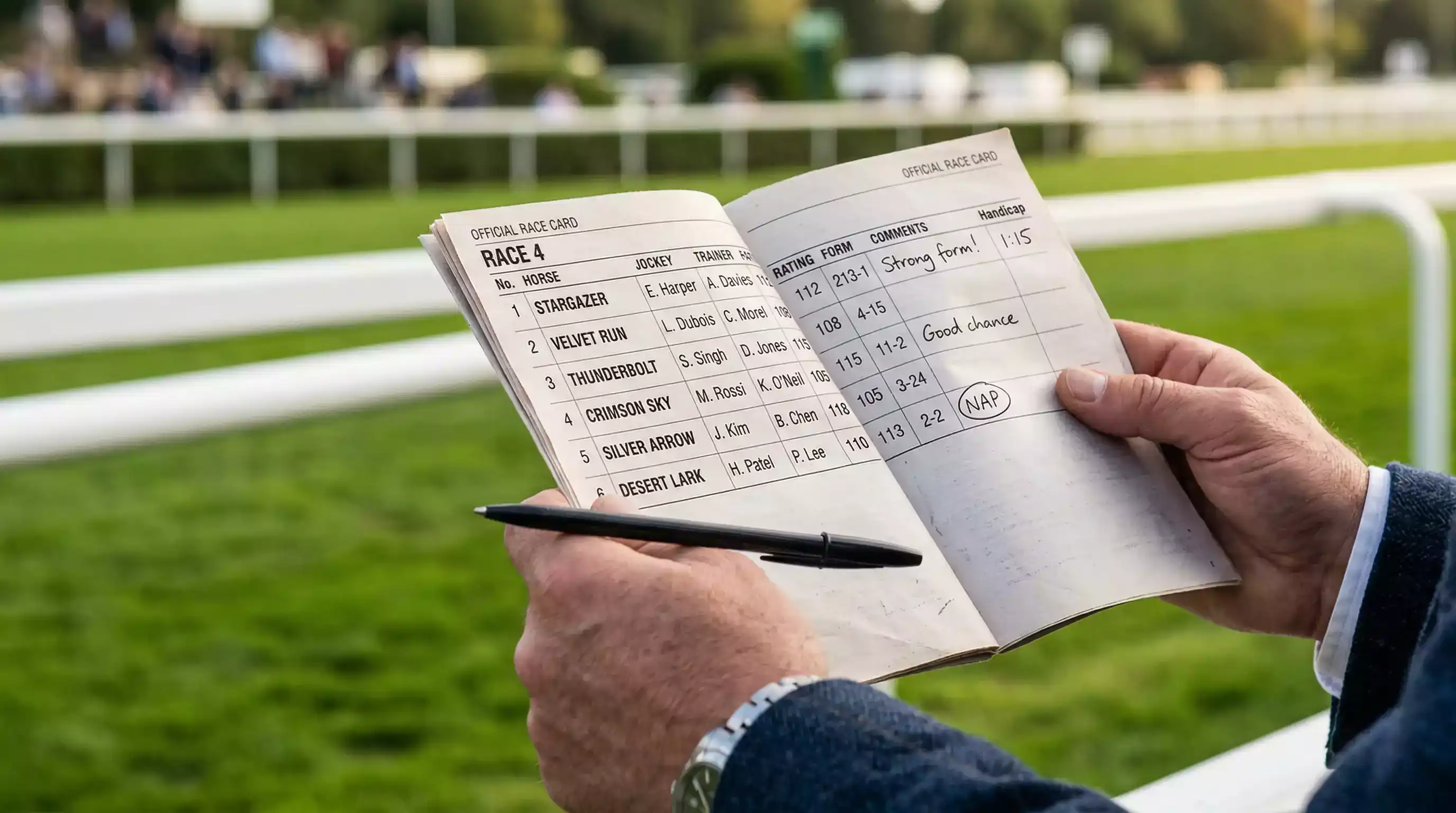
For a broader view of the racecard information that feeds these handicap assessments — Official Ratings, weight, draw, and form — the racecard reading guide covers every element.
What does ‘well-handicapped’ mean?
A well-handicapped horse is one whose Official Rating is considered lower than its true ability. This can happen because the horse has been running in unsuitable conditions, has had a break and improved, or has changed trainers. When a well-handicapped horse encounters the right conditions, it can outperform its rating and win at a price that reflects its official mark rather than its actual talent.
Can a horse’s handicap mark go down after a bad run?
Yes. The handicapper adjusts ratings after every run. If a horse performs below expectations — finishing well beaten in a race it was expected to be competitive in — its Official Rating may be lowered. Multiple poor runs can lead to significant drops. This is one way horses become well-handicapped: they run poorly for a period, their rating drops, and when they return to form, they are competing off an artificially low mark.
Published by the First bet Horse Racing team.