Each-Way Betting in Horse Racing: How Place Terms, Payouts and Field Size Work Together
 Available in US
Table of Contents
- Two Bets in One: How Each-Way Gives Beginners a Safety Net
- Win Only vs Each-Way: When the Extra Stake Is Worth It
- Place Terms by Field Size: The Essentials
- Calculating Your Each-Way Payout Step by Step
- Each-Way in Handicap Races and Big Fields
- Extra-Place Promotions: What Bookmakers Offer and Why
- Three Each-Way Mistakes That Cost New Punters Money
- Frequently Asked Questions
Two Bets in One: How Each-Way Gives Beginners a Safety Net
My first each-way bet was an accident. I ticked the wrong box on a betting slip at Newbury, turned a 5 pound win bet into a 10 pound each-way, and nearly panicked when I saw double the money leave my account. The horse finished second. I got paid. If I’d placed the win bet I intended, I’d have lost everything. That accidental tick taught me more about horse racing betting than any guide I’d read up to that point.
An each-way bet is two bets in one: a win bet and a place bet, at equal stakes. If your horse wins, both halves pay out. If it finishes in the places — usually second or third, depending on the race — the place half pays at a fraction of the win odds. If it finishes outside the places, you lose both stakes. The total cost is always double whatever unit you choose: a 5 pound each-way bet costs 10 pounds (5 on the win, 5 on the place).
For beginners, each-way betting reduces the all-or-nothing nature of a straight win bet. In a sport where 68% of racecourse visitors in 2025 were either casual or first-time attendees, that safety net matters. You don’t need your horse to win to get a return — just to run well enough to finish in the frame. It’s a gentler introduction to the economics of racing, and it remains the most popular bet type among UK punters who are still finding their feet.
That said, each-way isn’t always the smart play. There are situations where it costs you money you didn’t need to spend, and situations where it transforms an average-looking price into a strong bet. The rest of this guide separates the two.
I should note upfront that each-way mechanics connect directly to how fractional and decimal odds work. If you’re not yet comfortable converting odds into payouts, brush up on that first and come back. Everything here builds on that foundation.
Win Only vs Each-Way: When the Extra Stake Is Worth It
I backed a horse at Kempton last winter at 8/1 each-way for 5 pounds each way — 10 pounds total. It finished third. The win half lost, but the place half paid at one quarter of 8/1 (that’s 2/1), returning 15 pounds — my 5 pound place stake plus 10 pounds profit. Net result: I staked 10 pounds and got back 15 pounds. A 5 pound profit from a horse that didn’t even win. If I’d bet 10 pounds to win, I’d have lost the lot.
Now flip the scenario. A horse at 2/1 in a five-runner race. Each-way terms here are 1/4 of the odds for the first two places. The place odds are just 1/2 — half your money back plus your stake if it places. If the horse finishes second, a 10 pound each-way bet returns only 7.50 pounds on the place half (5 pound stake returned plus 2.50 profit), against a total outlay of 10 pounds. You still lose 2.50. The each-way safety net has a hole in it when the odds are short.
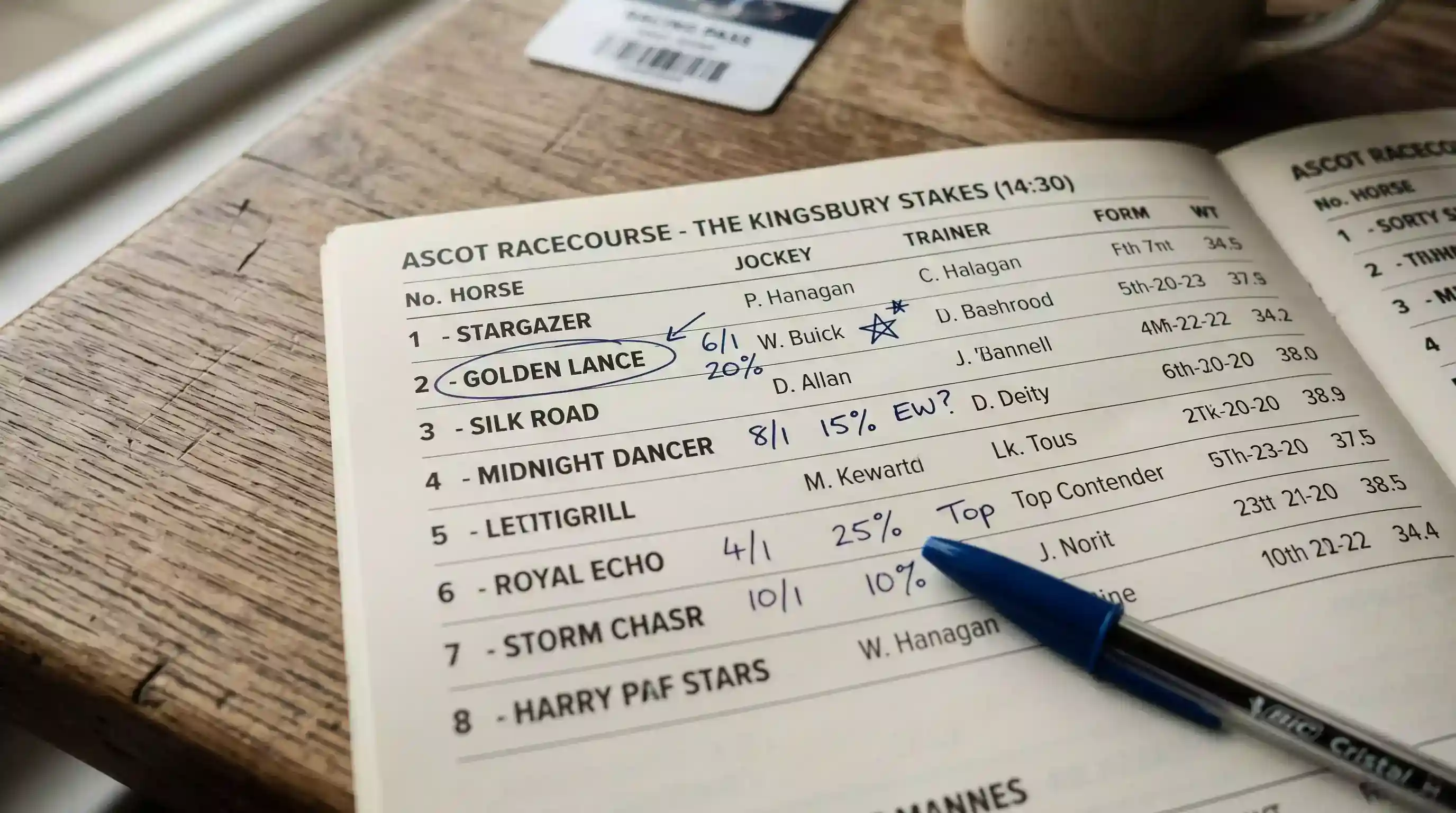
The crossover point where each-way starts making financial sense depends on the place terms and the odds, but as a working rule: each-way becomes attractive at prices of roughly 5/1 and above in standard place-term races. Below that, the place return often doesn’t cover the doubled stake when the horse places but doesn’t win. Above that, the place fraction generates meaningful returns that justify the extra cost.
There are exceptions. In big-field handicaps where bookmakers pay four or more places, each-way at shorter prices can work because the probability of placing is significantly higher. And in races where you think a horse has a genuine winning chance but also a strong place chance — maybe it’s well drawn, the going suits it perfectly, but there’s one dominant favourite ahead of it — each-way captures both possibilities at a reasonable cost.
Win-only betting is cleaner and simpler. It forces you to commit to a selection rather than hedging. I place the majority of my bets as win-only, especially in smaller fields, because the all-or-nothing nature sharpens my analysis. I’m more disciplined about which horses I back when every penny rides on first place. Each-way, by contrast, tempts you into backing horses you don’t quite believe in because “at least it’ll place.” That’s a costly habit if it becomes your default.
The question I ask myself before every bet: would I still back this horse if each-way didn’t exist? If the answer is yes, the each-way option becomes a genuine hedge on a selection I believe in. If the answer is no — if the only reason I’m considering the horse is the safety net of a place return — I walk away. That single filter has improved my each-way record more than any mathematical formula.
Place Terms by Field Size: The Essentials
Place terms dictate how many finishing positions count as “placed” and what fraction of the win odds the place half pays. They’re set by field size — the number of runners declared for a race — and they’re non-negotiable. Get them wrong and you’ll miscalculate your potential return before you’ve even placed the bet.
The standard framework across most UK bookmakers works as follows. In races with 2 to 4 runners, there are no place terms at all — each-way bets are void on the place half, and only win bets apply. With 5 to 7 runners, bookmakers typically pay first and second at one quarter of the win odds. With 8 to 15 runners, first, second and third pay at one fifth of the odds. In handicap races of 16 or more runners, first through fourth pay at one quarter of the odds. Some festivals and big events extend this to five or even six places — but that enters promotional territory, which I’ll cover shortly.
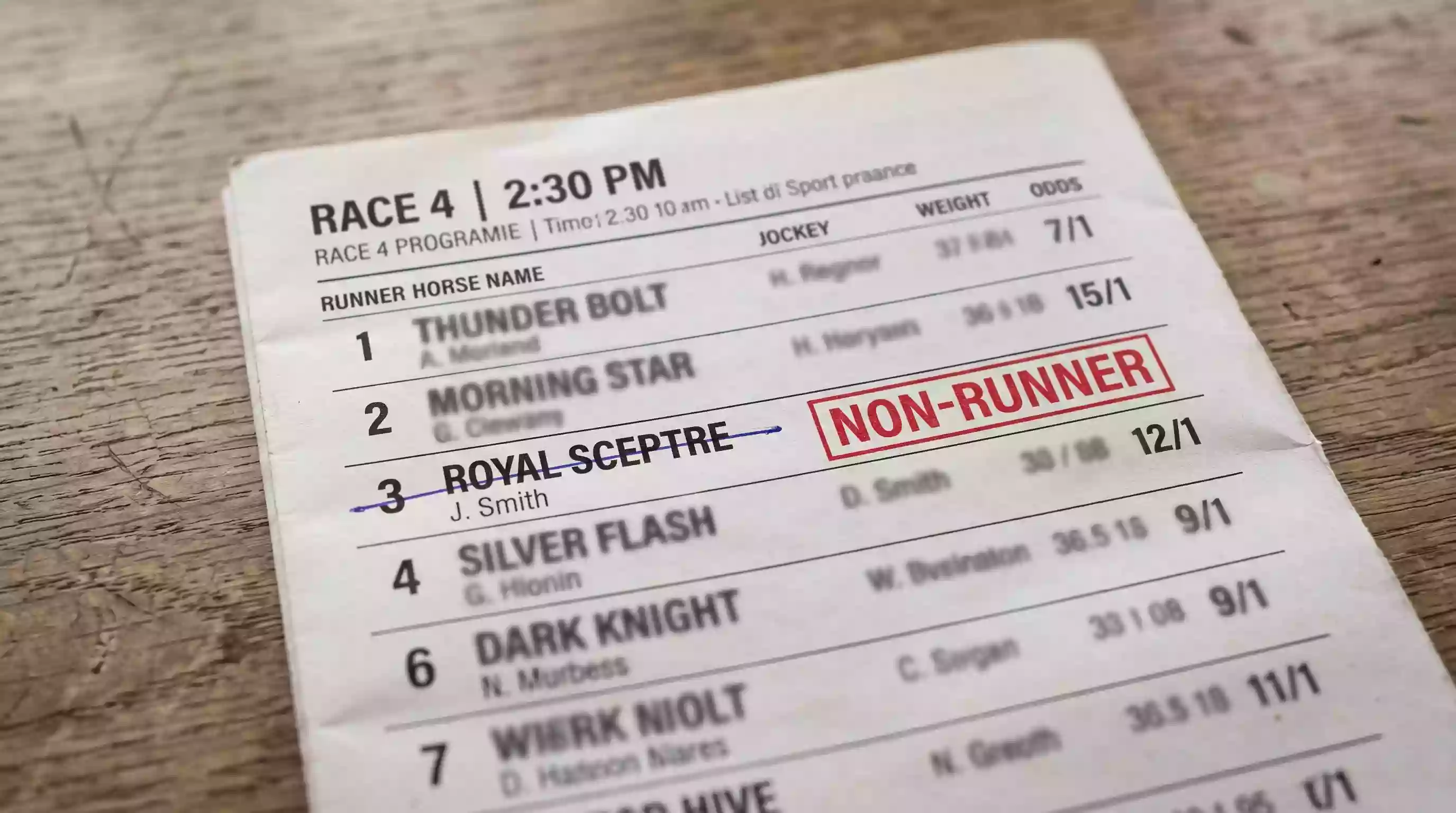
The crucial thing to check before placing any each-way bet is the actual number of declared runners, not the number at the overnight stage. Horses get withdrawn on the morning of a race — sometimes an hour before the off. If a race drops from 8 runners to 7, the place terms change. Where moments ago three horses paid, now only two do. Your each-way calculation shifts dramatically, and if you’ve already placed the bet, you’re stuck with the new terms.
For a more detailed reference including festival exceptions, promotional variations and how non-runners alter the picture mid-market, I’ve put together a full guide to place terms by field size that covers the edge cases this summary leaves out.
Calculating Your Each-Way Payout Step by Step
Nothing makes each-way click like running through the numbers with real stakes. I’m going to walk through three scenarios using a horse priced at 10/1 in a 12-runner race. Place terms: 1/5 of the odds for the first three places. Your stake: 5 pounds each way (10 pounds total).
Scenario 1: The horse wins. Both the win and place halves pay out. The win half returns 5 pounds at 10/1 — that’s 50 pounds profit plus the 5 pound stake, totalling 55 pounds. The place half pays at one fifth of 10/1, which is 2/1. That’s 10 pounds profit plus the 5 pound stake, totalling 15 pounds. Combined return: 55 + 15 = 70 pounds. Subtract the 10 pound total outlay: 60 pounds profit.
Scenario 2: The horse finishes second or third. Only the place half pays. The win half loses, costing you 5 pounds. The place half at 2/1 returns 15 pounds. Net result: 15 minus 10 (total outlay) = 5 pounds profit. Not a fortune, but you’re in the green despite your horse not winning.
Scenario 3: The horse finishes fourth or worse. Both halves lose. You’re down 10 pounds.
Now let me run the same exercise at 4/1 with the same place terms. Win half if it wins: 20 plus 5 = 25. Place half at 4/5 (one fifth of 4/1): 4 plus 5 = 9. Total return on a win: 34 pounds, less 10 outlay = 24 profit. If it places but doesn’t win: 9 return less 10 outlay = minus 1 pound. You actually lose money when a 4/1 shot places at 1/5 odds. This is the trap I mentioned earlier — each-way at short prices can mean placing and still losing.
The formula for any each-way calculation breaks into two clean steps. Step one: calculate the win return as normal (odds multiplied by stake, plus stake). Step two: divide the odds by the place fraction denominator (4 for quarter odds, 5 for fifth odds), then calculate that return the same way. Add both halves together and subtract your total outlay. You can do this on a phone calculator in about 15 seconds once you’ve practised it a few times.
I keep a simple spreadsheet on my phone that auto-calculates each-way returns. I plug in the odds, the place fraction, and my intended stake, and it spits out the three scenarios instantly — win, place, lose. It takes the guesswork out and stops me from placing each-way bets that would actually lose money on a place finish. I’d recommend any beginner build something similar, even if it’s just a note with the formula written out.
Each-Way in Handicap Races and Big Fields
Big-field handicaps are where each-way betting comes alive. The Grand National alone attracts around 250 million pounds in bets each year — a single race generating more turnover than entire race meetings elsewhere in the calendar. A field of 40 runners means bookmakers pay four places at quarter odds as standard, with many extending to five or six places through promotions. The probability of your horse finishing in the frame is significantly higher than in a six-runner novice chase, and the odds are longer because the field is more competitive.
Handicap races are designed to give every horse a theoretical chance by adjusting the weight each carries. The better the horse, the more weight it shoulders. The result is fields where a 33/1 outsider has a genuine, form-justifiable shot at placing — and at 33/1 with quarter-odds place terms (33/4 = approximately 8/1 for the place), the place return alone can be substantial. A 2 pound each-way bet on a 33/1 shot that finishes third returns 2 pounds at 8.25/1 = 18.50 pounds, plus the 2 pound stake = 20.50 pounds. From a 4 pound total outlay, that’s a 16.50 pound profit without your horse winning.
The sweet spot for each-way handicap betting, in my experience, sits between 12/1 and 25/1. Below 12/1, the place return in a big field is often too thin to justify the doubled stake. Above 25/1, you’re backing horses whose chance of even placing is marginal — the long odds reflect genuine unlikelihood, not hidden value. Between 12/1 and 25/1, you’re in territory where the place odds alone can return a meaningful profit and the horse typically has enough form credentials to justify a top-four finish.
One thing to watch: handicap fields shrink on the day. A race that closes with 22 declarations might go to post with 16 after morning withdrawals. If it drops below 16, the place terms change — from four places to three. Check the final declarations before committing to an each-way bet in any handicap, and pay particular attention to the weather forecast, which is the biggest single driver of late withdrawals.
Festival handicaps deserve special attention. All 28 races at the 2025 Cheltenham Festival ranked among the top 31 most-bet-upon races of the entire year. These fields attract maximum each-way value because bookmakers compete aggressively on place terms, the field sizes are consistently large, and the market depth means the odds tend to be fairer — lower overrounds, more accurate pricing. If you’re going to experiment with each-way handicap betting, a festival Saturday is the place to start. The markets are deeper, the promotions are better, and the fields are big enough to give you genuine placing chances on horses at double-figure prices.
Extra-Place Promotions: What Bookmakers Offer and Why
Every Saturday during the jumps season, my inbox fills with emails from bookmakers shouting about “extra places” on the big race. It sounds like marketing fluff until you do the maths — and then it turns out to be one of the few promotional edges that genuinely shifts the odds in your favour.
An extra-place promotion means the bookmaker pays out on more finishing positions than the standard terms require. A race that normally pays three places might pay four, five, or even six under the promotion. The win odds and the place fraction stay the same — the only change is how many horses qualify as “placed.” The effect is dramatic. In a 14-runner race with standard 1/5 odds for three places, your horse needs to finish in the top 21% of the field to trigger the place payout. Add one extra place and that threshold shifts to the top 28%. Add two and it’s 35%. You haven’t changed your selection or your stake — you’ve just widened the net.
The Horserace Betting Levy Board collected a record 108.9 million pounds in levy payments during the 2024-25 financial year, which tells you bookmaker revenues remain robust despite falling turnover. Alan Delmonte, the HBLB’s chief executive, pointed out that February and March 2025 produced significantly higher than usual bookmaker gross margins — partly shaped by bookmaker-friendly outcomes at the Cheltenham Festival. Promotions like extra places are funded from those margins. Bookmakers offer them because they drive volume on marquee races, and the cost is manageable when spread across thousands of bets. For individual punters, though, the value is concentrated — you’re getting better terms than the standard market offers, and the bookmaker is absorbing the difference.
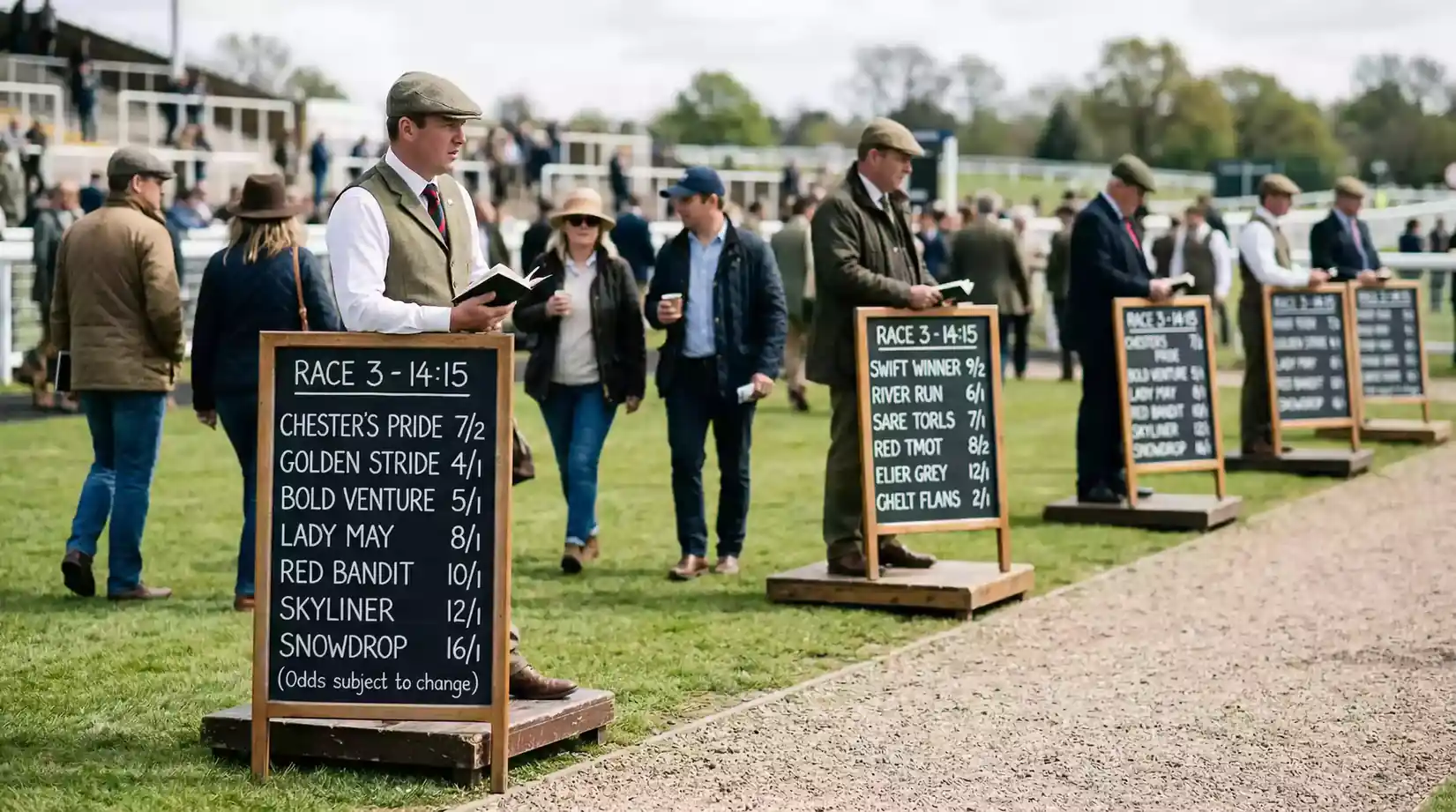
I use extra-place races to make each-way bets I wouldn’t normally consider. A horse at 14/1 in a race paying three places might not excite me each-way. The same horse in the same race paying five places? Now the place probability looks different, and I’m willing to commit. The key discipline is to check which races carry the promotion before you bet, not after. Most bookmaker apps flag extra-place races clearly on the racecard page, and some let you filter for them directly.
A word of caution: don’t let extra-place promotions pull you into races you wouldn’t otherwise bet on. The promotion improves the terms, but it doesn’t improve your selection. Backing a horse with poor form at 20/1 each-way with five places is still a bad bet if the horse has no realistic chance of finishing in the frame. The promotion should enhance a bet you’ve already justified through your own analysis, not create one from scratch.
Three Each-Way Mistakes That Cost New Punters Money
BHA research through Project Beacon found that complexity of terminology and form interpretation ranks among the top barriers preventing new audiences from engaging with horse racing. Each-way betting sits right at the intersection of that complexity — and the mistakes beginners make reflect the confusion.
Mistake one: treating each-way as a cheaper alternative to a win bet. It isn’t cheaper. A 5 pound each-way costs 10 pounds. If you only have 5 pounds to spend and you want the each-way safety net, your unit stake is 2.50 pounds each way, not 5 pounds. I’ve watched people at the track bet 10 pounds each way thinking they’re spending 10 pounds. They’re spending 20. Doubling your outlay without realising it is the fastest way to blow through a betting bank, and it happens constantly.
Mistake two: backing each-way at short prices in small fields. A horse at 3/1 in a six-runner race, with place terms of 1/4 of the odds for first and second. If it finishes second, the place return at 3/4 (0.75/1) on a 5 pound stake is 3.75 pounds plus the 5 pound stake — 8.75 pounds back from a 10 pound outlay. You lose 1.25 pounds on a placed horse. The maths doesn’t work in your favour until the win odds reach a level where the place fraction generates a meaningful return. Run the numbers before you bet, every single time.
Mistake three: ignoring the number of runners. Place terms change with field size, and field size changes on the morning of the race. I’ve been caught out by this myself — placed an each-way bet the night before, woke up to three withdrawals, and found that my race had dropped from eight runners to five. What was three places at 1/5 odds became two places at 1/4 odds. The whole proposition changed and I couldn’t undo the bet. Now I never place each-way bets until I’ve confirmed the final declarations, which usually means waiting until about an hour before the race. That patience has saved me money dozens of times.
Frequently Asked Questions
Does each-way double my total stake?
Yes. An each-way bet is two separate bets at equal stakes — one on the win, one on the place. A 5 pound each-way bet costs 10 pounds total. Always calculate your total outlay as double the unit stake before placing the bet.
How many places are paid in a race with fewer than eight runners?
In races with 5 to 7 runners, most bookmakers pay the first two places at one quarter of the win odds. In races with 2 to 4 runners, each-way betting is not available and only win bets apply.
Can I place an each-way bet on an odds-on favourite?
You can, but it rarely makes financial sense. The place fraction of an odds-on price produces very small returns — often less than your original stake. At 4/6 with quarter-odds place terms, the place odds are just 1/6, meaning you’d need to stake 6 pounds to profit 1 pound on the place half alone.
If a horse in my each-way bet is withdrawn, do the place terms change?
They can. If withdrawals reduce the field below a place-term threshold — for example, from 8 runners to 7 — the number of paying places and the place fraction will change. Your bet remains live but at the new terms. Always check final declarations before placing each-way bets.
Written by the editors at First bet Horse Racing.