Horse Racing Bet Types Explained: Singles, Multiples, Forecasts and Specials
 Available in US
Table of Contents
- More Than Just Win or Lose: A Map of UK Bet Types
- Singles: Win and Each-Way at a Glance
- Forecast and Tricast: Predicting the Exact Order
- Accumulators, Doubles and Trebles
- Full-Cover Bets: Lucky 15, Trixie, Patent, Yankee
- Ante-Post Betting: Risks and Rewards of Betting Early
- Speciality Markets: Top Jockey, Winning Distance, Match Bets
- Which Bet Types to Start With and Which to Avoid
- Frequently Asked Questions
More Than Just Win or Lose: A Map of UK Bet Types
When I started betting on racing, I thought there were two options: pick a horse to win, or don’t bet. It took months before I discovered that the UK betting market offers dozens of bet types, each with its own mechanics, risk profile and strategic purpose. Some of them are brilliant tools. Some are traps dressed up as excitement. Knowing which is which matters more than most beginners realise.
There are 24.4 million active online betting accounts in the UK. The vast majority of those account holders stick to the same one or two bet types — usually win singles and the occasional accumulator — without ever exploring the rest of the menu. That’s not necessarily wrong. Simplicity has value. But it does mean missing opportunities that the wider range of bet types creates, and it means exposure to risks you don’t need to take.
This guide walks through every major bet type available in UK horse racing, from the simplest single to the most complex full-cover multiple. For each one, I’ll explain how it works, show you a worked example, and give you my honest assessment of whether it belongs in a beginner’s toolkit. Not all of them do.
Before we start, one principle to keep in mind: complexity in betting is not sophistication. The most complex bet types generate the highest bookmaker margins and the lowest long-term returns for punters. If you understand how odds work, you already have the foundation for every bet type that follows. The odds determine the payout; the bet type determines how many things need to go right for you to collect it.
Singles: Win and Each-Way at a Glance
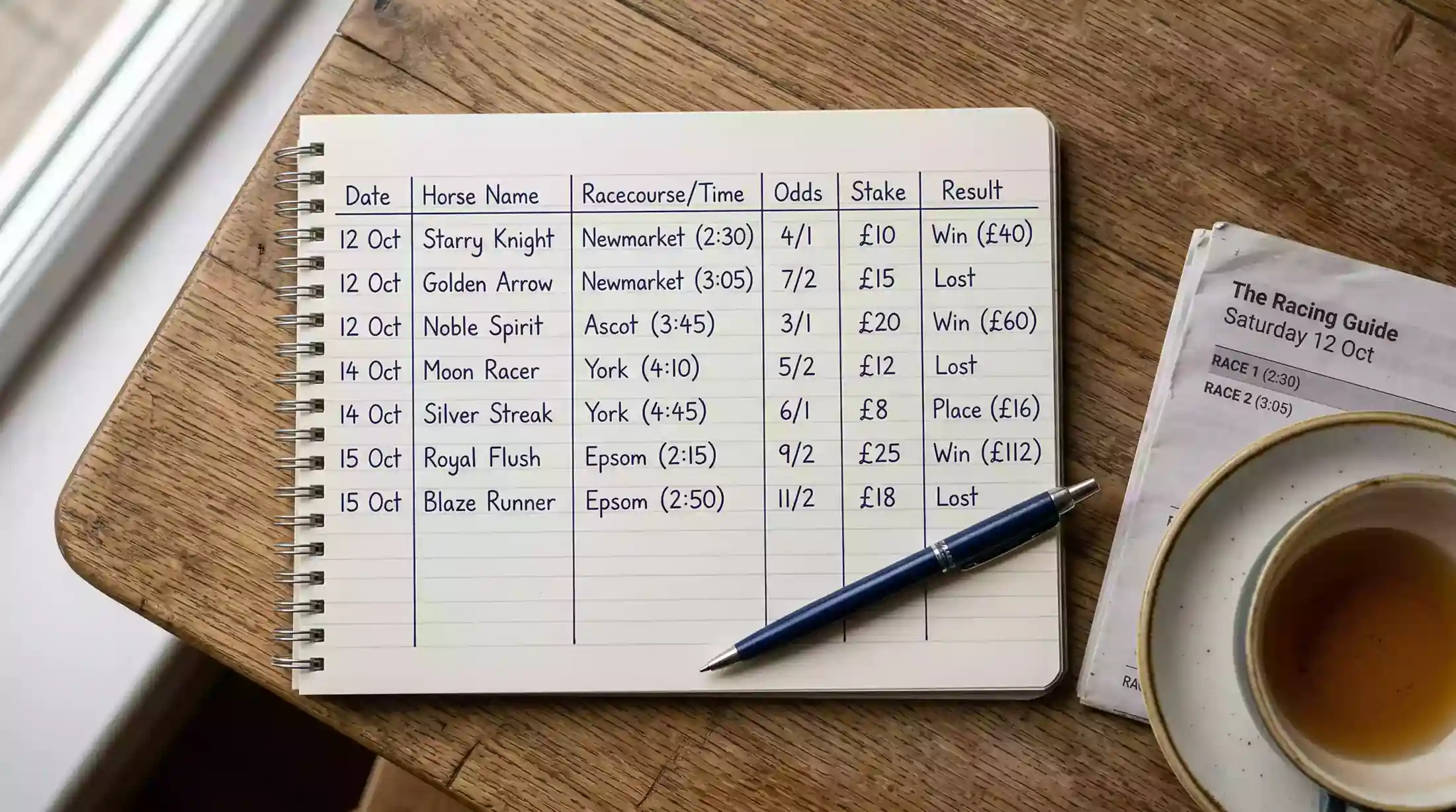
The single bet is the foundation of everything. One horse, one race, one outcome. If it wins, you get paid. If it loses, you lose your stake. There are no moving parts, no dependencies on other results, and no hidden calculations. A 10 pound single on a horse at 5/1 returns 60 pounds if it wins and nothing if it doesn’t.
Each-way is a single’s close relative — two bets on the same horse at equal stakes, one for the win and one for a place finish. I’ve covered each-way in detail in a separate guide, so I won’t repeat the mechanics here. The key point for this overview is that an each-way bet costs double the unit stake, which catches new punters off guard more often than any other misunderstanding in racing.
Singles are where I place roughly 80% of my bets. The reason is mathematical: every additional selection you add to a bet compounds the probability of losing. A single on a horse with a 25% chance of winning gives you a 25% chance of a return. Add a second horse at 25% and your chance of both winning drops to 6.25%. The maths punishes complexity, and singles keep that complexity to zero.
Forecast and Tricast: Predicting the Exact Order
I once watched two horses pull 15 lengths clear of the field at Ascot and thought, “That was obvious — everyone could see those two were the class acts.” A straight forecast on the pair would have paid over 30/1. Obvious in hindsight, but predicting the exact finishing order — first and second — is genuinely difficult, and the payouts reflect that difficulty.
A forecast bet requires you to name the first and second horse in the correct order. Horse A first, Horse B second. If they finish the other way around, you lose. A reverse forecast covers both permutations — A first and B second, or B first and A second — but costs double because it’s two bets. The payout on a straight forecast is calculated by the bookmaker using a formula based on the individual odds of each horse, and it’s typically much larger than either horse’s individual win price would suggest.
A tricast takes the concept further: first, second and third in the exact order. The precision required is extreme, the probability of success is tiny, and the payouts can be extraordinary. I’ve seen tricasts on competitive handicaps pay over 1,000/1 from a 1 pound stake. They’re lottery-adjacent in terms of likelihood, but unlike the lottery, they’re built on a sport where form analysis can tilt probability in your favour — even if only slightly.
Combination forecasts and tricasts let you select more than the minimum number of horses and cover all possible finishing orders within that group. Selecting three horses in a combination forecast generates six bets (three horses, two positions, all permutations). Selecting four horses in a combination tricast generates 24 bets. The coverage is broader but the cost multiplies fast, so check the total stake before confirming.
My view on forecasts for beginners: they’re fun as occasional bets at small stakes in races where you have a strong view on two or three horses. They shouldn’t be a regular part of your betting because the hit rate is low and the variance is high. But for a big-field handicap where you’ve identified two horses you think will dominate, a small reverse forecast can deliver returns that a simple win bet never could.
One detail worth knowing: computer straight forecasts (CSF) and tricast dividends are calculated differently from bookmaker forecasts. The CSF is determined by an industry formula after the race, based on the starting prices of the placed horses. Bookmaker forecasts use the firm’s own method, which can produce different returns. If you place a forecast with a bookmaker, the payout is at their calculated price. If you use the Tote or a pool-based system, the dividend depends on the pool size and the number of winning tickets. Either way, check how the payout is calculated before you bet — the difference between the two methods can be significant.
Accumulators, Doubles and Trebles
The accumulator is the bet type that sells dreams. Four horses, all must win, and if they do, the returns are staggering. I’ve seen 50p accumulators pay out five figures. I’ve also watched thousands of accumulators die on the final leg, which is the far more common experience.
A double links two selections: both must win for the bet to pay. The returns from the first winner roll into the second as the stake. A 5 pound double on two horses at 3/1 and 4/1 works out as: first horse wins, returning 20 pounds (5 x 4.00 in decimal). That 20 pounds becomes the stake on the second horse at 4/1, returning 100 pounds (20 x 5.00). Your profit from a 5 pound outlay is 95 pounds. A treble adds a third selection — all three must win, and the returns compound further.
An accumulator extends the chain to four or more selections. The Grand National alone generates around 250 million pounds in bets, and a significant portion of that comes through accumulators linking the National with other races on the card. The appeal is obvious: small stakes, life-changing potential returns. The reality is that accumulators are the most profitable bet type for bookmakers, not for punters. Each leg you add multiplies the bookmaker’s margin alongside your potential payout. A four-fold accumulator on horses with a 15% overround each effectively carries a compounded margin well above what any single bet would cost you.
The maths is unforgiving. Four horses each with a 50% chance of winning — which is generous for most selections — combine for a 6.25% chance of all four winning. At realistic probabilities, most accumulators have a success rate in low single digits. The few that land pay handsomely, which keeps people coming back, but the long-term expected return is consistently negative.
If you enjoy accumulators — and many people do, myself included on occasion — treat them as entertainment with a capped budget, not as a strategy. Set aside a small portion of your betting bank for multiples and don’t chase losses when they inevitably fail. The 50p four-fold on a Saturday afternoon is perfectly fine as long as it’s a sideshow, not the main event.
One tip that’s served me well: if you’re tempted by a four-horse accumulator, consider placing four separate singles instead. The total outlay is higher, but you don’t need all four to win to see a return. A single winner at 4/1 from four 2 pound singles gives you 10 pounds back from a 8 pound outlay — a profit. The same horses in a 2 pound accumulator return nothing unless all four win. Singles are less glamorous but they keep money flowing back into your bank, and that liquidity matters when you’re learning.
Full-Cover Bets: Lucky 15, Trixie, Patent, Yankee
Full-cover bets exist because someone looked at the accumulator and thought, “What if I didn’t need all of them to win?” That question produced an entire category of bet types that cover multiple combinations of your selections, giving you returns even when some legs lose.
The Lucky 15 is the most popular. It takes four selections and generates 15 bets: 4 singles, 6 doubles, 4 trebles and 1 four-fold accumulator. If just one horse wins, you get paid on its single. If two win, you collect on both singles and their double. If all four win, every one of the 15 bets pays out, and many bookmakers add a bonus on top. The catch: a 1 pound Lucky 15 costs 15 pounds. A 2 pound Lucky 15 costs 30 pounds. The coverage is broad but the entry price is steep relative to a simple single.
The Trixie uses three selections to create 4 bets: 3 doubles and 1 treble. No singles, so you need at least two winners to get a return. The Patent is the same three selections but adds the three singles, making 7 bets total — you get paid if just one horse wins. The Yankee takes five selections across 11 bets (10 doubles, 10 trebles, 5 four-folds, 1 five-fold) and requires at least two winners for a return.
The Heinz (57 bets from 6 selections), Super Heinz (120 bets from 7) and Goliath (247 bets from 8) extend the concept further, but at stake levels that put them well beyond beginner territory. A 1 pound Goliath costs 247 pounds. Unless you’re very confident in eight selections simultaneously, that’s not a realistic outlay.
My honest view: full-cover bets are best used sparingly, on days when you have a strong opinion on three or four races and want to maximise the return from multiple winners without needing all of them to come in. They’re a middle ground between the all-or-nothing accumulator and the conservative single. But the unit-stake multiplication means you need to plan your outlay carefully. I’ve written a detailed walkthrough of the Lucky 15 for anyone who wants to understand the mechanics in full before committing.
Ante-Post Betting: Risks and Rewards of Betting Early
In February 2025, I backed a horse for the Cheltenham Gold Cup at 16/1. By the time the festival arrived in March, the same horse was 6/1. The value in ante-post betting — placing bets weeks or months before a race — comes from getting an early price before the market catches up. All 28 races at the 2025 Cheltenham Festival ranked among the most heavily bet contests of the entire year, and the ante-post markets for those races open months in advance.
The trade-off is risk. Ante-post bets come with no non-runner refund. If your horse is injured, retired, aimed at a different race, or simply doesn’t make the cut, you lose your stake with no recourse. The bookmaker isn’t being unfair — the generous odds you received were priced to reflect exactly that risk. You got 16/1 instead of 6/1 because there was a genuine chance the horse wouldn’t run.
The best ante-post opportunities tend to emerge in two windows: immediately after a horse wins impressively and the bookmaker opens an early market on the next big target, and during the final two to three weeks before a major festival when the declarations narrow the field. The first window carries maximum risk and maximum potential reward. The second carries less risk because you know the horse is likely to run, but the prices have already shortened from their peak.
For beginners, I’d suggest limiting ante-post bets to the biggest races — Grand National, Cheltenham Gold Cup, Champion Hurdle, Derby — where the markets are deepest and the information flow is most transparent. And never bet ante-post money you can’t afford to lose without a race being run. That sounds like obvious advice, but the sting of losing a stake to a horse that doesn’t even make it to the start hits differently from a horse that simply gets beaten.
One practical tip: if you do bet ante-post and the horse’s price shortens significantly before the race, you’ve “locked in” value regardless of the result. Some punters use betting exchanges to lay off part of the position, guaranteeing a profit. That’s an advanced move, but knowing it exists gives ante-post betting a dimension that day-of-race betting lacks — the price itself becomes tradeable.
Speciality Markets: Top Jockey, Winning Distance, Match Bets
Beyond the standard bet types, UK bookmakers offer speciality markets that let you bet on outcomes other than which horse wins a race. These markets expand during major festivals and offer a different angle for punters who want variety.
Top jockey betting lets you back a rider to have the most winners across a meeting — typically a multi-day festival like Cheltenham or Royal Ascot. The market factors in the quality of each jockey’s book of rides, their historical record at the course, and the strength of the yards they’re associated with. Alan Delmonte, chief executive of the Horserace Betting Levy Board, has emphasised that racing needs to present itself in ways that attract the modern consumer — and these broader markets do exactly that, turning a four-day festival into a single narrative you can follow from start to finish.
Winning distance markets let you bet on how far the winner will beat the second horse. Match bets pit two horses against each other regardless of where they finish in the race — you’re betting on which of the two finishes ahead of the other. Trainer markets work like top jockey but aggregated by stable. Each of these removes the need to pick the actual winner, which can be a refreshing change from the standard win-or-lose dynamic.
I use speciality markets occasionally, mostly during festivals when I have a strong opinion about a jockey’s book of rides or when two horses in the same race look inseparable and a match bet removes the noise of the wider field. They’re not core to my betting — singles remain the priority — but they add texture on the big days and sometimes highlight value that the main markets don’t.
Which Bet Types to Start With and Which to Avoid
42% of UK bettors rate their overall experience positively, with another 35% describing it as neutral. The bet types you choose have a direct impact on which camp you end up in. Start with the wrong ones and the losing streaks will feel longer, the bank will drain faster, and the sport will seem stacked against you.
Start with win singles. No hedging, no compounding, no coverage bets. One horse, one race, one decision. Learn what it feels like to win at 7/2 and lose at 4/6. Understand the relationship between price and probability through direct experience. Win singles teach you to be selective because every bet is a clear pass-or-fail, and that selectivity is the single most valuable habit in betting.
Add each-way bets once you’re comfortable with the payout mechanics. Use them in the right spots — big-field handicaps at double-figure prices — and avoid them in small fields at short odds. Then, after a few months, experiment with the occasional forecast or Lucky 15 when you have strong opinions on multiple races. Keep those bets at minimal stakes until you understand how the returns and risks compound.
Avoid accumulators as a primary bet type. Avoid complex full-cover bets until you’ve mastered the singles that make up their components. Avoid in-play betting until you’ve developed real-time race-reading skills. And avoid ante-post entirely until you understand the non-runner risk and can absorb the occasional complete write-off without it affecting your next decision.
The bet types that generate the most excitement for beginners — accumulators and tricasts — are the ones that generate the most profit for bookmakers. That’s not a coincidence. The bet types that feel boring — disciplined win singles on well-researched selections — are where informed punters build sustainable results. Boring wins. Eventually.
Frequently Asked Questions
What is the difference between a forecast and a tricast?
A forecast requires you to predict the first and second finishers in the correct order. A tricast requires first, second and third in the correct order. Tricasts are harder to land but pay significantly more. Both can be placed as straight bets (exact order) or combination bets (covering all permutations of your selected horses).
How many selections do I need for a Lucky 15?
A Lucky 15 requires exactly four selections. These generate 15 bets: 4 singles, 6 doubles, 4 trebles and 1 four-fold accumulator. The minimum cost is 15 times your chosen unit stake — so a 1 pound Lucky 15 costs 15 pounds.
What are the main risks of ante-post betting compared to day-of-race bets?
The primary risk is that your horse might not run, and ante-post bets carry no non-runner refund. You can also lose your stake if the horse is redirected to a different race, fails a veterinary check, or is retired before the event. The compensation for this risk is typically longer odds than you would get on the day of the race.
Is an accumulator a good bet for beginners?
As a regular strategy, no. Accumulators compound both the bookmaker’s margin and the probability of losing. Each selection you add reduces your chance of success dramatically. As an occasional entertainment bet at small stakes, they can be enjoyable — but they should never form the core of a beginner’s betting approach.
Published by the First bet Horse Racing team.