
National Hunt vs Flat Racing: Key Differences Every Beginner Should Understand
 Available in US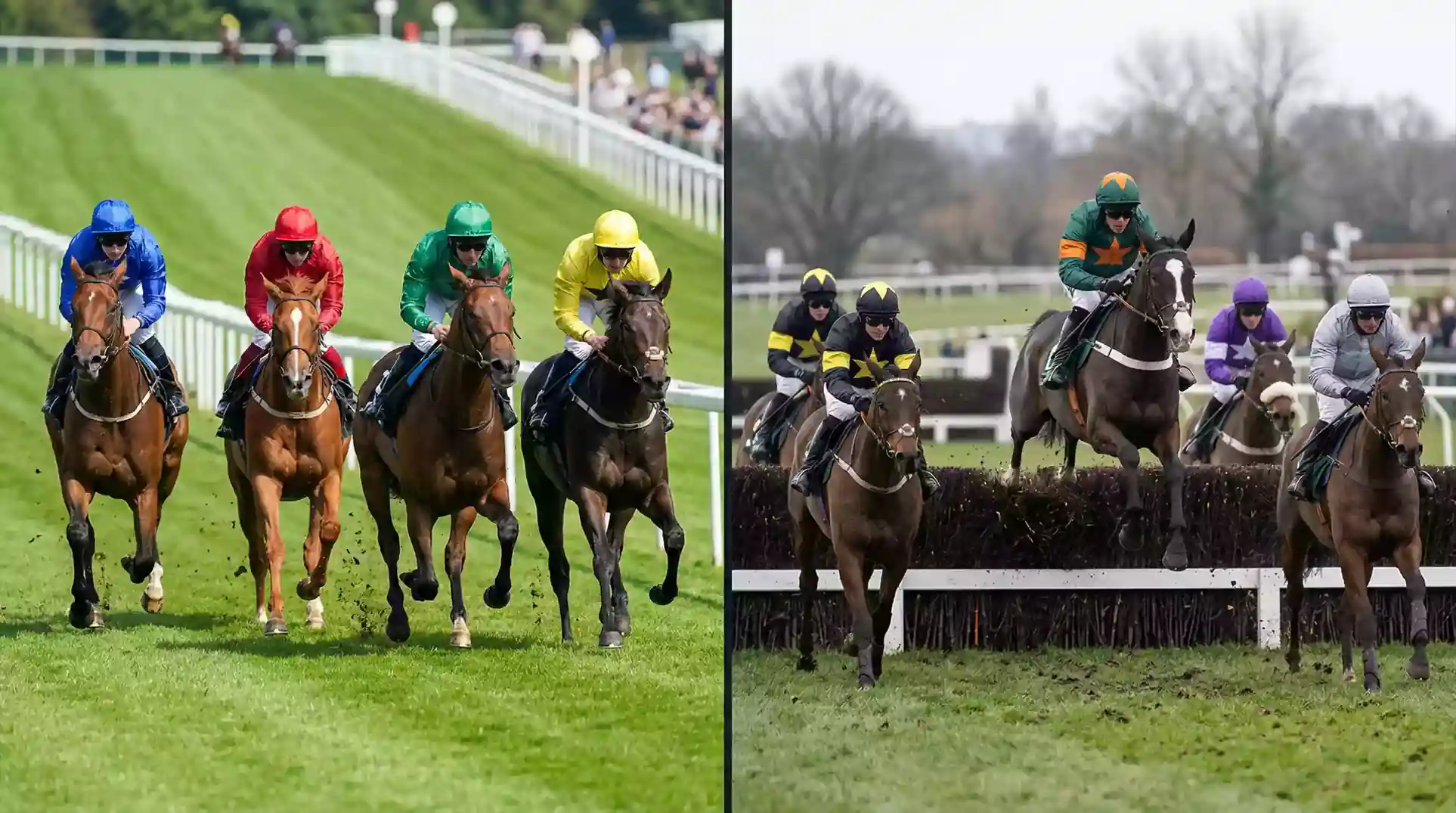
Two Codes, Two Seasons, Two Betting Approaches
When I first started following horse racing, I assumed it was all the same sport. Horses running around a track, fastest one wins. It took about three meetings to realise that watching a five-furlong sprint at Ascot and a three-mile chase at Cheltenham are about as similar as watching a 100-metre dash and a marathon. They share a species and a track, and that is roughly where the overlap ends.
Total prize money in British racing reached a record 194.7 million pounds in 2025, split between two distinct codes: flat racing and National Hunt (jumps). Each code has its own season, its own race types, its own breed preferences, and — critically for bettors — its own dynamics that affect how you analyse form and place bets. Understanding the differences is not academic. It directly shapes your approach to every bet you place.
Race Types, Distances and Obstacles
Flat racing is exactly what the name suggests: horses run on a level surface with no obstacles. Distances range from five furlongs (roughly 1,000 metres) to two miles four furlongs. Races are pure tests of speed, acceleration, and tactical positioning. A flat horse’s career might span two or three seasons, and the emphasis is on athleticism and precocity.
National Hunt racing introduces obstacles. Hurdle races use flexible barriers about three and a half feet high, designed to be brushed through rather than cleared with dramatic jumps. Chase races — steeplechases — use solid fences up to four and a half feet high, often with ditches on the take-off or landing side. Distances range from two miles to four miles and beyond, with the Grand National’s four-and-a-half-mile distance sitting at the extreme. National Hunt horses are typically older, tougher, and built for endurance. Careers lasting eight or nine seasons are common.
The presence of obstacles changes the betting equation fundamentally. On the flat, a horse with superior speed and form should win barring bad luck in running. Over jumps, even the best horse can fall, unseat its rider, or make a critical jumping error at any fence. That additional variable means National Hunt results are inherently less predictable, and favourites win less often than they do on the flat.
When Each Code Runs: The UK Calendar Split
Racecourse attendance surpassed 5.031 million in 2025, spread across both codes throughout the year. The calendar is roughly divided along seasonal lines, though there is more overlap than most beginners assume.
The flat season runs primarily from April to October on turf, with all-weather racing filling the winter months at synthetic-surface tracks like Lingfield, Kempton, and Wolverhampton. The prestige flat meetings — the Guineas at Newmarket, the Derby at Epsom, Royal Ascot, Glorious Goodwood, the St Leger at Doncaster — are concentrated in the spring and summer. This is when the best flat horses compete and when the highest-quality form is produced.
The National Hunt season occupies the opposite end of the calendar, running from October to April on turf. The Cheltenham Festival in March is the pinnacle, followed by the Grand National at Aintree in April. The Kempton Christmas meeting (home of the King George VI Chase) and the Leopardstown Festival in Ireland are other major fixtures. Summer jumping does exist at smaller meetings, but the quality drops significantly and the fields are weaker.
For a bettor, this seasonal structure means you can follow racing year-round by switching codes. Many serious punters focus on flat racing in summer and jump racing in winter, adapting their analysis methods to the code in season. Others specialise exclusively in one code, developing deeper expertise in exchange for covering fewer months of the year.
How the Code You’re Watching Changes Your Bet
On the flat, speed figures and race times carry significant analytical weight. A horse that has run 5 furlongs in 58 seconds on good ground at Ascot has produced a measurable performance. You can compare that time directly to other horses who have raced at the same track on similar ground. The data is precise and relatively reliable.
Over jumps, time-based analysis is far less useful. Jumping errors slow horses unpredictably, ground conditions vary more dramatically through the winter, and the longer distances amplify the effect of pace — a race run at a crawl for two miles before a sprint finish produces a completely different time from one run at a genuine gallop throughout. Form figures, visual assessment, and jumping ability become the dominant factors.
Going preferences matter in both codes but play out differently. On the flat, the going spectrum typically ranges from firm to good to soft. Extremes are less common because flat racing avoids very heavy ground. Over jumps, the full spectrum from good to heavy is in play throughout the winter, and the difference between soft and heavy can transform a race from a test of ability to a test of survival. A horse that handles soft ground comfortably might flounder in heavy ground — the step between those two descriptions is larger in National Hunt racing than most beginners realise.
Each-way betting shifts in emphasis too. Flat handicaps with large fields offer excellent each-way value because the place terms extend to four places at one-fifth the odds. National Hunt handicaps also offer extended places, but the fall and non-completion rate means your horse needs to finish the race before place terms even become relevant. I always factor in a horse’s completion rate over fences before placing an each-way bet in a chase — a horse that has fallen in two of its last five starts is not a reliable each-way proposition regardless of its form when it stays on its feet.
For a deeper understanding of the racecard data that drives analysis across both codes, the racecard reading guide covers every field and symbol.
Do some horses switch between flat and National Hunt?
Yes. Dual-purpose horses compete in both codes, though it is relatively uncommon at the elite level. Some trainers run horses on the flat during summer and over hurdles during winter. More often, horses transition from one code to the other permanently — ex-flat horses moving to hurdles is a well-established pathway. Their flat speed can give them an edge over purpose-bred jumps horses, particularly in two-mile hurdle races.
Is National Hunt betting more volatile than flat racing?
Generally, yes. The presence of obstacles introduces variables — falls, jumping errors, unseated riders — that do not exist on the flat. These variables reduce the favourite’s win rate and increase the frequency of unexpected results. Big-field National Hunt handicaps, particularly chases, are among the most unpredictable races in the calendar. This volatility creates opportunities for each-way value but also means losses are more frequent.
Written by the editors at First bet Horse Racing.