Expected Value in Horse Racing: How to Think About Every Bet as a Long-Term Proposition
 Available in US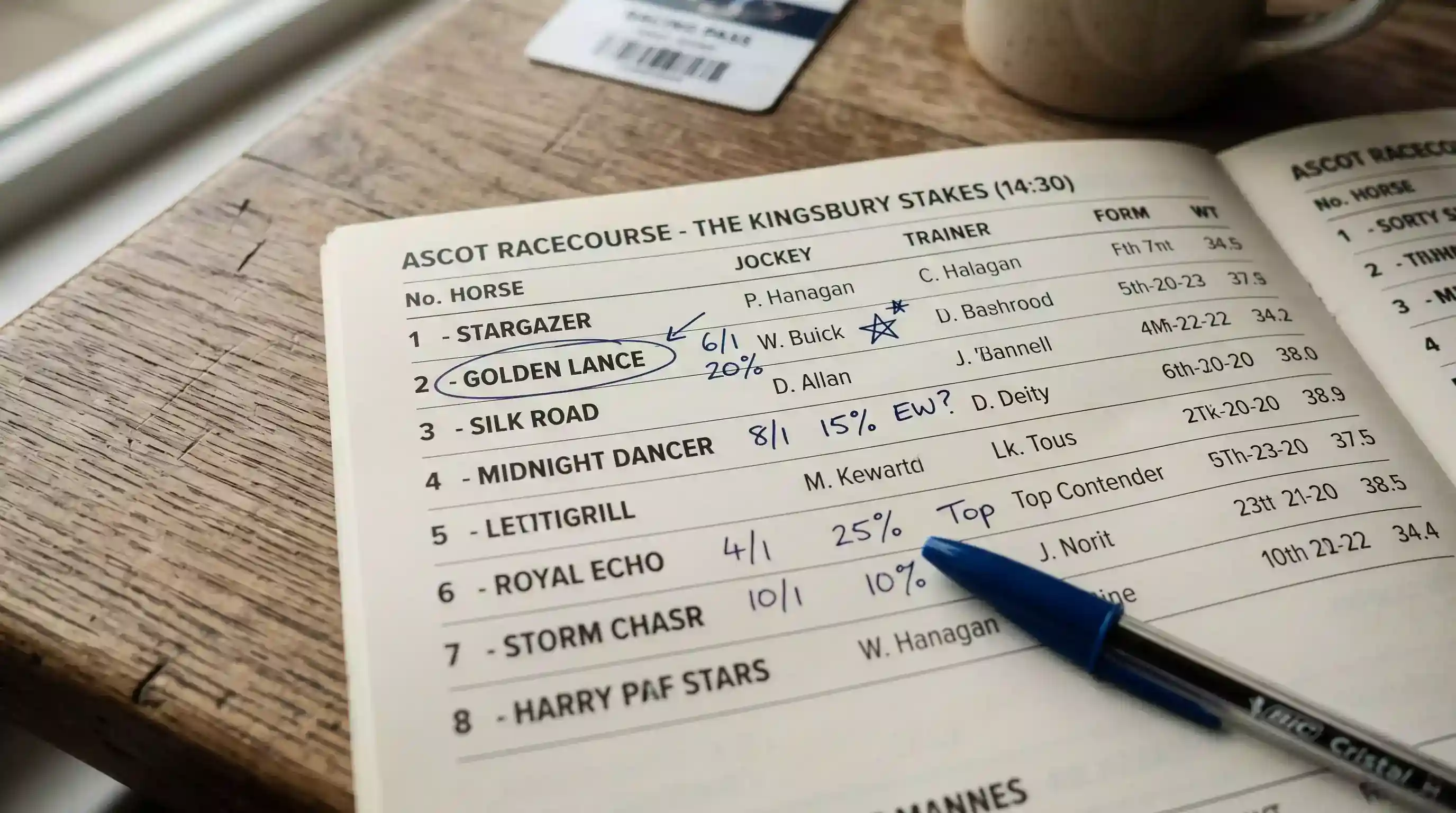
Every Bet Has a Price Tag: The Expected Value Concept
I spent my first three years betting on horse racing without ever thinking about expected value. I focused on picking winners, which seemed like the obvious goal. Then a friend who traded financial markets asked me a question that changed everything: “You backed a 4/1 winner yesterday — but was 4/1 actually a good price?” I did not understand the question. Now I know it is the only question that matters.
The UK online horse racing betting market generates 766.7 million pounds in gross gaming revenue annually. That figure represents the aggregate amount bettors lose to bookmakers across all races, all bets, all odds. The bookmaker does not win because it picks more winners than you do. It wins because it sets prices that are systematically lower than the true probability of each outcome. Expected value — EV — is the concept that quantifies that gap.
Expected value tells you whether a bet, repeated many times at the same odds, would produce a profit or a loss over the long run. A positive-EV bet is one where the odds offered are better than the true chance of the horse winning. A negative-EV bet is one where the bookmaker’s price is worse than the real probability. Every winning punter in history has understood this distinction, whether they called it “expected value” or simply “getting value.”
Converting Odds to Implied Probability
Before you can calculate EV, you need to convert betting odds into implied probability — the chance of winning that the odds represent. The conversion is straightforward.
For fractional odds, the formula is: stake divided by (stake plus profit) times 100. A horse at 4/1 has an implied probability of 1 / (1 + 4) x 100 = 20 percent. The bookmaker’s price implies the horse has a 20 percent chance of winning. At 2/1, the implied probability is 33.3 percent. At even money (1/1), it is 50 percent. At 1/2 (odds-on), it is 66.7 percent.
For decimal odds, the calculation is even simpler: 1 divided by the decimal odds times 100. Decimal 5.0 (which is the same as 4/1) gives 1/5.0 x 100 = 20 percent. Decimal 3.0 (which is 2/1) gives 33.3 percent.
Here is the critical point: if you add up the implied probabilities of every runner in a race, the total will exceed 100 percent. It might come to 115 or 120 percent. That excess is the overround — the bookmaker’s built-in margin. Every horse in the market is priced as though it has a slightly higher chance of winning than it actually does. The overround guarantees that if the bookmaker’s prices are accurate, it profits regardless of which horse wins.
Calculating Expected Value Step by Step
Overall betting turnover on British racing fell 9 percent in the first quarter of 2025, partly because experienced punters are becoming more selective — and selectivity is driven by EV calculations. Here is how to work through one.
Suppose a horse is offered at 6/1. The implied probability is 14.3 percent. But after studying the form, the going, the trainer’s strike rate, and the pace dynamics of the race, you believe the horse has a genuine 20 percent chance of winning. That is your assessed probability — your own estimate of the horse’s true chance.
Expected value is calculated as: (probability of winning x profit per unit) minus (probability of losing x stake per unit). With a one-pound stake at 6/1, if you believe the true probability is 20 percent, the calculation is: (0.20 x 6) – (0.80 x 1) = 1.20 – 0.80 = +0.40. The EV is positive: plus 40 pence per pound staked. Over many bets at this edge, you would expect to profit.
Now flip the scenario. The horse is 6/1, but you think its true chance is only 10 percent. The calculation is: (0.10 x 6) – (0.90 x 1) = 0.60 – 0.90 = -0.30. Negative EV: minus 30 pence per pound staked. Even if the horse wins occasionally, you are losing money over time at this price relative to its actual chance.
The calculation is simple. The hard part — the part that separates profitable bettors from recreational ones — is estimating the true probability accurately. Your assessment is a judgement, not a measurement. It can be wrong. The more races you study, the more form you read, the more patterns you recognise, the better your assessments become. But perfection is not the goal. The goal is to be right more often than the market, even slightly, and to bet only when you believe the gap between your probability and the bookmaker’s implied probability is meaningful.
How to Identify Positive-EV Opportunities
Positive EV does not announce itself. There is no flashing sign on the racecard that says “this horse is underpriced.” You have to find it through analysis, and the edges are usually small — 5 or 10 percentage points between your assessed probability and the implied probability from the odds.
The most common sources of positive EV in horse racing are situations where the market is reacting to surface-level information while missing something deeper. A horse that ran poorly last time might be dismissed by casual punters who look only at the most recent form figure. But if that poor run was on unsuitable ground, over the wrong distance, or after a troubled passage in running, the horse’s true ability is higher than the last result suggests. The market has anchored to the visible result. Your analysis has looked beneath it.
Horses returning from a break are another fertile area. A horse with no recent form is hard for the market to price accurately, which means the odds are more likely to be wrong — in either direction. If you follow a trainer who excels with horses first time back from a layoff, you have information that the broader market may not weight heavily enough.
Weather-driven changes are a third source. When the going changes on the morning of racing, the market adjusts — but not always quickly or accurately enough. If you have already identified which horses in a race will benefit from or suffer from the change in conditions, and the market has not fully reflected that shift in the prices, you have a temporary edge.
The discipline is in restraint. Not every race offers a positive-EV bet. Some days, after working through the card, I find nothing. That is fine. The objective is to bet only when the maths is in your favour, not to bet on every race because it is there.
For a more detailed breakdown of how odds work, how overround is constructed, and where bookmaker margins hide, the odds explained guide covers the pricing side in full.
Does positive expected value mean I will win every time?
No. Positive EV means that if you placed the same bet many times at the same odds, you would expect to profit over the long run. Any individual bet can still lose. A horse with a genuine 25 percent chance of winning will lose three times out of four, regardless of whether the odds represent positive EV. The edge only materialises over a large sample of bets — dozens or hundreds, not one or two.
How does the overround affect expected value?
The overround is the bookmaker’s built-in margin. It ensures that the implied probabilities of all runners in a race add up to more than 100 percent. This means every horse in the market is priced as though its chance is slightly lower than the odds suggest. To find positive EV, your assessed probability of a horse winning needs to exceed the inflated implied probability from the odds — you are effectively overcoming the overround with superior analysis.
Created by the ”First bet Horse Racing” editorial team.