Can You Make Money Betting on Horse Racing? What the Numbers Say
 Available in US
The Honest Answer Most Betting Guides Won’t Give You
Nine years of analysing horse racing markets and placing thousands of bets has given me one conclusion that most betting content carefully avoids: the majority of people who bet on horse racing lose money over the long term. Not because they are foolish, not because the sport is rigged, but because the system is mathematically structured to produce that outcome. The UK online horse racing market generates 766.7 million pounds in gross gaming revenue annually — and GGY is, by definition, the total amount bettors lose to operators. That figure exists because the house has a built-in edge on every market.
That does not mean profit is impossible. It means the bar is higher than most beginners assume, and understanding where the bar sits is essential before you decide how seriously to take your betting.
The Bookmaker’s Built-In Edge
Cumulative losses in betting turnover on horse racing since 2022 total approximately 3 billion pounds in real terms. Those losses are driven partly by regulatory changes and migration to unlicensed markets, but the foundational reason is simpler: every bookmaker market is priced with an overround.
The overround means that if you add up the implied probability of every horse in a race based on the bookmaker’s odds, the total exceeds 100 percent. A typical UK horse racing market runs at 115 to 125 percent. That 15 to 25 percent excess is the bookmaker’s margin — it ensures that, on average, the operator profits regardless of which horse wins.
For a punter to profit, you must overcome that margin. On a market with a 120 percent book, the bookmaker is effectively charging you 20 percent for the privilege of betting. Your analysis, selection process, and staking discipline need to generate returns that exceed this built-in cost. It is the equivalent of running a race where the other competitors start 20 metres ahead of you. Winnable, but not by accident.
Betting exchanges reduce this cost by eliminating the overround entirely, charging a flat commission (typically 2 to 5 percent) on net winnings instead. The effective margin on exchange markets is substantially lower than on bookmaker markets, which is why many profitable bettors use exchanges as their primary platform.
Realistic ROI for Recreational vs Serious Punters
Nevin Truesdale, the former Chief Executive of the Jockey Club, observed that the Gambling Commission’s approach seemed oriented towards reducing gambling to small-stakes punters — an outcome he argued was unsustainable for the sport. That tension between regulation and participation runs through every conversation about betting profitability, because the practical environment — account restrictions, affordability checks, stake limits — directly affects a punter’s ability to extract value even when they find it.
For the average recreational bettor — someone who bets on weekend racing, follows a few trainers, and places each-way bets on horses they fancy — the expected long-term return is negative. A typical recreational bettor might sustain a loss of 5 to 15 percent of total stakes over a year. This is the entertainment cost of the hobby, analogous to spending money on cinema tickets or football matches. There is nothing wrong with this outcome, provided you have budgeted for it and are not chasing a profit that the numbers suggest will not come.
Serious recreational punters who invest time in form study, understand expected value, and bet selectively can reduce that loss margin to near break-even — losing 0 to 5 percent of stakes annually. Some break through into marginal profitability, returning 1 to 3 percent on total stakes over a season. This requires discipline, record-keeping, and a willingness to pass on far more races than you bet on.
Professional punters — those who treat betting as their primary or significant secondary income — typically target a return on investment of 3 to 8 percent over thousands of bets per year. That sounds modest until you consider the volumes involved. An 8 percent ROI on 200,000 pounds of annual turnover is 16,000 pounds. But maintaining that edge requires a level of analytical rigour, technological resource, and emotional control that most people underestimate.
What a Profitable Approach Actually Looks Like
Profitable horse racing betting is not about picking more winners. It is about identifying bets where the odds are in your favour — positive expected value — and sizing your stakes appropriately to survive the inevitable losing runs. A profitable bettor might win only 25 to 30 percent of their bets, which means losing 70 to 75 percent of the time. The profit comes from the winners paying at odds that more than compensate for the losers.
Specialisation is the most common path to profitability. Betting on every race across every meeting dilutes your analytical edge. Most successful bettors focus on specific niches: a particular course, a particular type of race (nursery handicaps, two-mile chases, big-field sprint handicaps), or a specific angle (first-time headgear, course-and-distance specialists, trainer patterns). Depth of knowledge in a narrow area is worth more than surface-level knowledge across the entire sport.
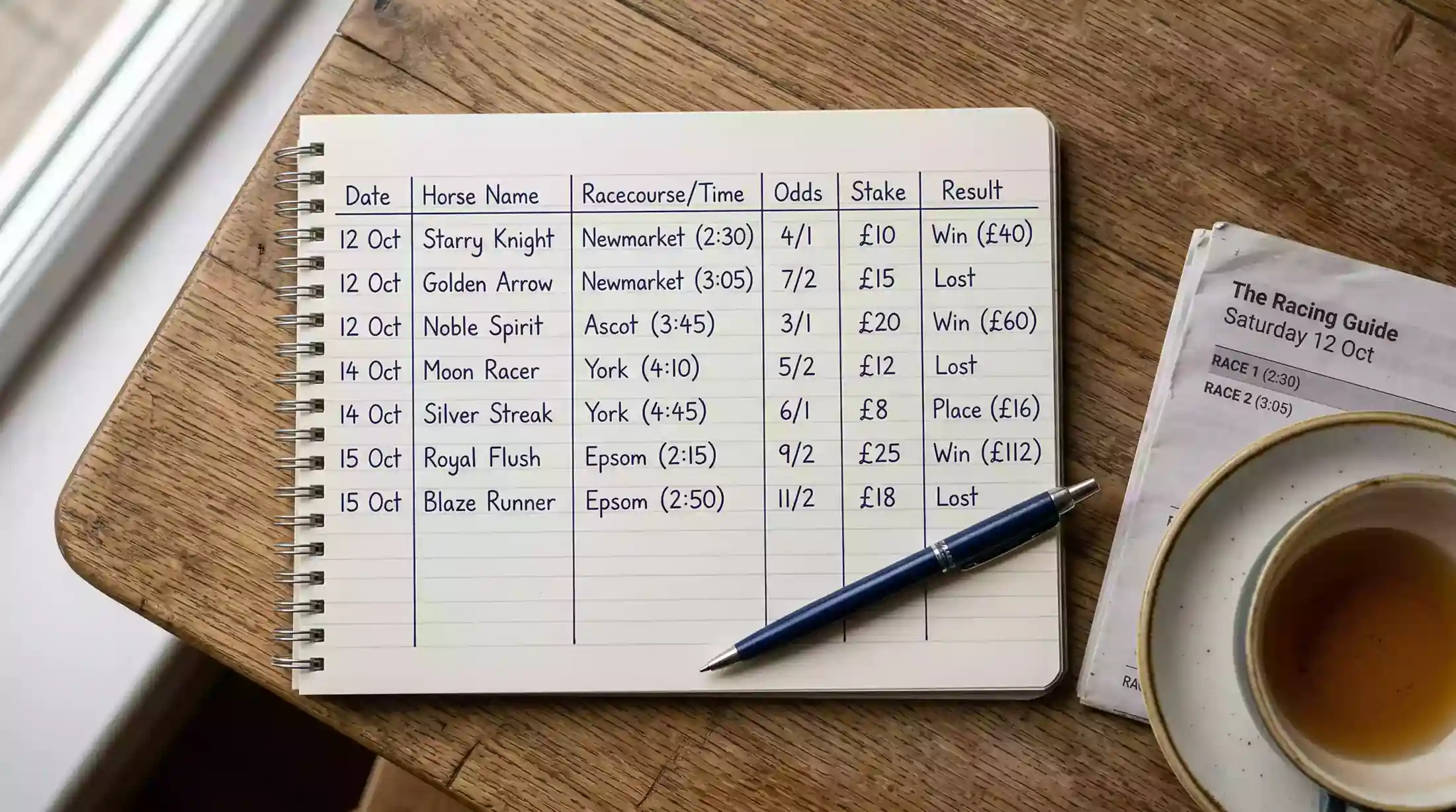
Record-keeping is non-negotiable. If you are not tracking every bet — selection, odds, stake, result, and your reasoning — you cannot evaluate whether your approach is working. Memory distorts results: you remember the 10/1 winner and forget the ten losers before it. A spreadsheet does not lie. After a hundred bets, the data tells you whether your strike rate, average odds, and staking are producing positive or negative returns. Without that data, you are guessing about whether you are guessing well.
Bankroll management is the final piece. Even a profitable strategy will experience losing runs of 10, 15, or 20 bets. If your stakes are too large relative to your betting bank, a normal losing run can wipe you out before the edge has time to play out. The standard advice — risking 1 to 2 percent of your bankroll per bet — exists because it gives a profitable strategy enough room to survive variance.
For the structural framework that supports all of this — setting a betting bank, choosing a staking plan, and tracking results — the bankroll management guide covers the detail.
What ROI do professional horse racing bettors typically achieve?
Most professional horse racing bettors operate in the 3 to 8 percent return-on-investment range over large samples of bets. This means for every 100 pounds staked, they return 103 to 108 pounds on average. Anything above 10 percent consistently is exceptional. These figures require thousands of bets per year, disciplined staking, and continuous adaptation to changing market conditions.
Does using betting exchanges improve long-term profitability?
Exchanges can improve profitability by offering better odds than bookmakers on many markets, because they do not build an overround into each price. The commission charged on winning bets is typically lower than the implicit cost of the bookmaker’s margin. Exchanges also offer the ability to lay horses, which opens strategic options unavailable with traditional bookmakers. However, exchanges require more knowledge to use effectively and have thinner liquidity on smaller meetings.
Written by the editors at First bet Horse Racing.